Blockchain technology has evolved from a niche concept supporting cryptocurrency to a transformative force reshaping industries worldwide. If you’ve heard about Bitcoin, NFTs, or digital currencies but remain puzzled about the underlying technology powering these innovations, you’re in the right place.
In 2025, blockchain is no longer just about cryptocurrency—it’s becoming the backbone of secure digital transactions, supply chain management, healthcare record-keeping, and even government services. The global blockchain technology market was valued at $20.16 billion in 2024 and is projected to grow from $31.18 billion in 2025 to $393.42 billion by 2032, demonstrating explosive growth that reflects its expanding real-world utility.
Over 560 million people worldwide—nearly 4% of the global population—use blockchain, while 659 million own cryptocurrencies, marking a 13% year-over-year increase. More importantly, blockchain adoption has moved beyond individual users to enterprises, with 52% of Fortune 500 companies reporting at least one blockchain project in production, not just in pilot.
This comprehensive beginner’s guide will demystify blockchain technology, explaining how it works, why it matters, and how it’s already changing the world around us. Whether you’re a curious learner, aspiring developer, business professional, or investor, understanding blockchain fundamentals has become essential for navigating our increasingly digital future.
What Is Blockchain Technology? Breaking Down the Basics
The Core Concept: A Digital Ledger for the Modern Age
At its foundation, blockchain is a shared, immutable digital ledger, enabling the recording of transactions and the tracking of assets within a business network and providing a single source of truth. Think of it as a digital notebook that’s copied and synchronized across thousands of computers simultaneously, where every transaction gets permanently recorded and can never be erased or altered.
Unlike traditional databases controlled by a single organization (like your bank maintaining your account records), blockchain distributes data across a network of computers (called nodes). These nodes work together to maintain a shared ledger of transactions.
Here’s what makes this revolutionary: traditional systems rely on intermediaries like banks, payment processors, or clearinghouses to maintain trust and verify transactions. Blockchain eliminates these middlemen by embedding trust directly into the technology itself through cryptography and consensus mechanisms.
The Name Explained: Why “Blockchain”?
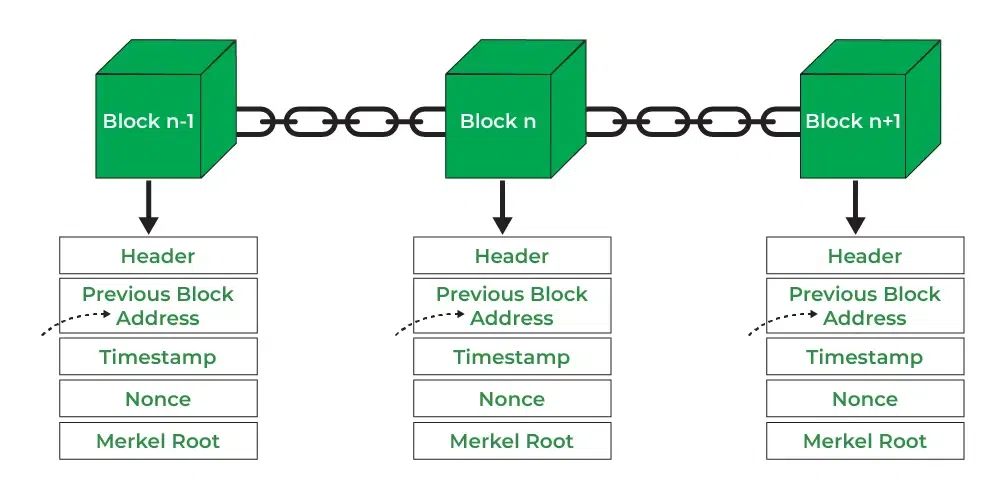
The term “blockchain” comes from how the technology structures data. Information is grouped into “blocks”—digital containers holding batches of transaction records. Each block contains:
- Transaction data: Details about what happened (who sent what to whom)
- Timestamp: When the transaction occurred
- Hash: A unique digital fingerprint identifying the block
- Previous block’s hash: A cryptographic link connecting it to the chain
Once a block fills up with data, it’s cryptographically sealed and linked to the previous block, forming a chain. This chain grows continuously as new blocks get added, creating a permanent, chronological record that extends back to the very first block (called the “genesis block”).
Simple Blockchain Structure
Key Defining Characteristics
Decentralization: No single authority controls the blockchain. Instead, thousands of independent computers (nodes) maintain identical copies of the entire ledger, working together through consensus mechanisms.
Immutability: Once data gets recorded in a block and added to the chain, it becomes extremely difficult (practically impossible) to alter. Changing historical data would require recalculating all subsequent blocks and convincing the majority of network participants to accept the altered version—a computationally prohibitive task.
Transparency: Most blockchains allow anyone to view transaction histories, creating unprecedented transparency. While you can see that a transaction occurred, the identities behind wallet addresses may remain pseudonymous.
Security: Advanced cryptographic techniques secure blockchain networks. Each participant receives cryptographic keys—a public key (like an email address anyone can see) and a private key (like a password only you know). Transactions require private key signatures, making unauthorized access extraordinarily difficult.
How Does Blockchain Work? The Step-by-Step Process
Understanding how blockchain operates might seem intimidating, but breaking it down into clear steps makes the process comprehensible.
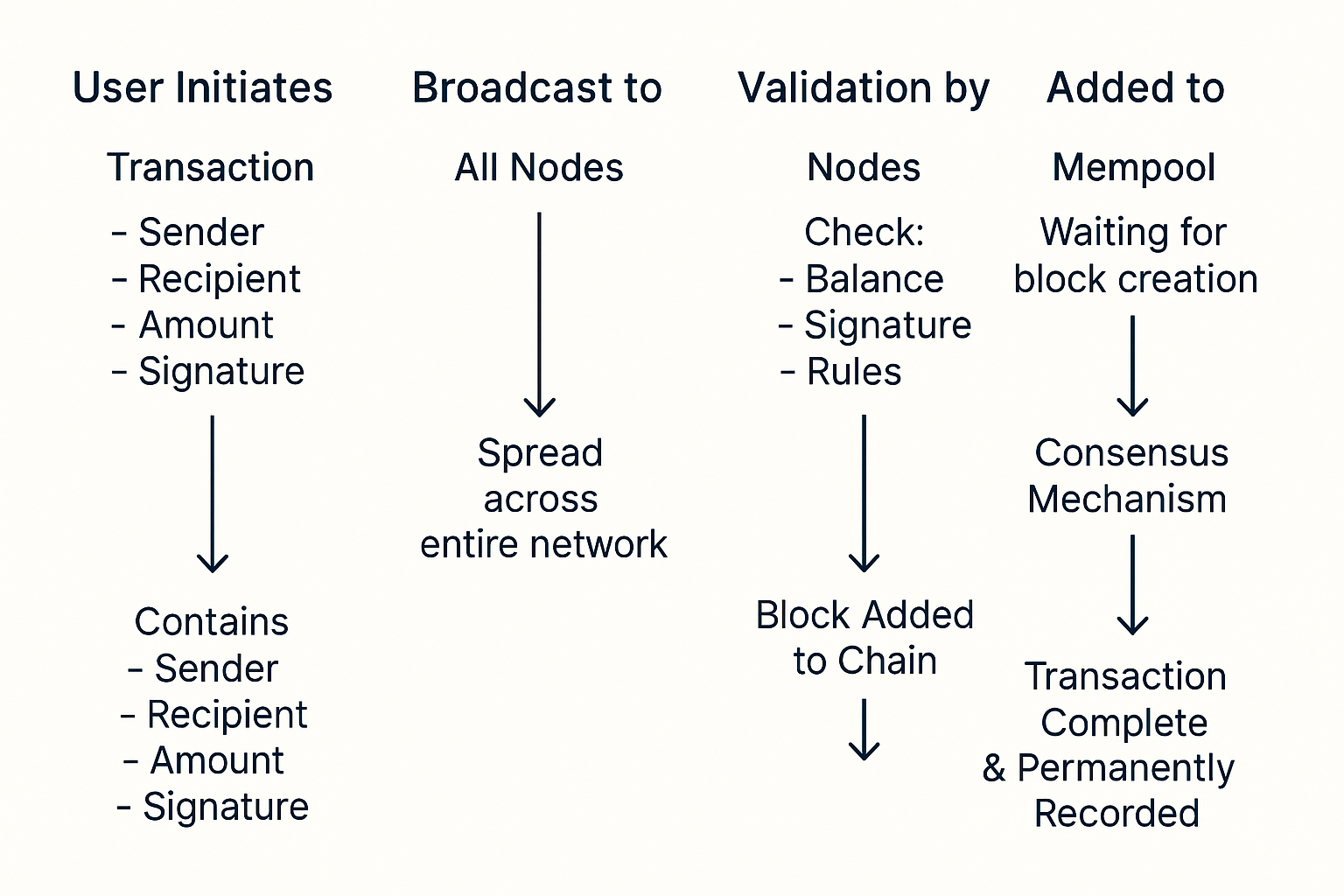
Step 1: Transaction Initiation
When someone wants to conduct a transaction—whether sending cryptocurrency, recording a supply chain event, or updating a medical record—they initiate the process by creating a transaction request. This request contains essential information:
- Sender’s digital signature (authenticated with their private key)
- Recipient’s public address
- Transaction details (amount, type, additional data)
- Timestamp
Step 2: Broadcasting to the Network
The transaction request gets broadcast to all nodes in the blockchain network. These nodes are individual computers running blockchain software that maintains a copy of the entire ledger.
Step 3: Validation Process
Network nodes validate the transaction by checking:
- Does the sender have sufficient balance or authorization?
- Is the transaction properly signed with the sender’s private key?
- Does the transaction follow network rules and protocols?
- Is the sender a registered participant in the network?
If the transaction passes these validation checks, nodes accept it as legitimate.
Step 4: Transaction Pooling
Validated transactions collect in a waiting area called a “mempool” (memory pool) where they wait to be included in the next block. Multiple transactions group together, forming a batch that will be packaged into a single block.
Step 5: Consensus Mechanism
This is where blockchain’s most innovative feature operates. To add a new block to the chain, network participants must reach consensus about the block’s validity. Two primary consensus mechanisms dominate:
Proof of Work (PoW): Used by Bitcoin, this method involves miners solving complex puzzles to validate transactions. Miners compete to solve cryptographic problems, and the first to succeed gets to add the block and receive rewards.
Proof of Stake (PoS): Used by Ethereum and many other blockchains in 2025, this energy-efficient model requires validators to stake tokens as collateral for transaction verification. Validators are selected based on their stake size and other factors, making the process more environmentally sustainable.
Step 6: Block Addition
Once consensus is reached and the block is validated, it gets added to the blockchain. The block receives a unique hash (digital fingerprint) and links to the previous block’s hash, creating the chain structure.
Step 7: Transaction Completion
With the block successfully added to the chain, the transaction is complete and permanently recorded. All nodes update their copies of the blockchain to include this new block, maintaining synchronization across the network.
How a Transaction Works on Blockchain:
Types of Blockchain Networks: Finding the Right Fit
Not all blockchains are created equal. Different types serve different purposes, offering varying levels of access, control, and transparency.
Public Blockchains
Public blockchain networks are open for anyone to join and participate in, such as the Bitcoin blockchain. These completely decentralized networks allow anyone to:
- View all transaction histories
- Participate in consensus mechanisms
- Submit transactions
- Run a node maintaining the ledger
Advantages: Maximum transparency, censorship resistance, true decentralization
Disadvantages: Slower transaction speeds, higher energy consumption (especially PoW), limited privacy
Examples: Bitcoin, Ethereum, Cardano, Solana
Private Blockchains
Private blockchains restrict access to authorized participants only. A single organization or consortium controls who can join the network, view data, and validate transactions. These permissioned systems prioritize efficiency and privacy over public transparency.
Advantages: Faster transactions, greater privacy, customizable governance, reduced energy consumption
Disadvantages: Less decentralized, requires trust in the controlling entity, reduced transparency
Examples: Hyperledger Fabric, R3 Corda, enterprise blockchain platforms
Hybrid Blockchains
Hybrid blockchains combine elements of both public and private networks, offering flexibility for organizations needing selective transparency. Certain data remains private while other information gets published publicly, creating customizable access controls.
Advantages: Flexible privacy settings, controlled access with public verification options, scalable performance
Disadvantages: More complex to implement, potential trust issues depending on design
Examples: Dragonchain, XinFin
Consortium Blockchains
Consortium blockchains represent a middle ground where multiple organizations share control rather than a single entity or completely open access. Pre-selected organizations jointly manage the network, making consensus faster than public blockchains while maintaining decentralization benefits.
Advantages: Faster than public chains, shared control among trusted parties, more decentralized than private chains
Disadvantages: Less transparent than public blockchains, requires coordination between organizations
Examples: Energy Web Chain, IBM Food Trust
Real-World Applications: Where Blockchain Makes an Impact in 2025
Blockchain’s practical applications extend far beyond cryptocurrency, transforming numerous industries with tangible benefits.
Financial Services and Banking
Banking holds the largest share at 29–30%, driven by blockchain’s adoption in cross-border payments, trade finance, and digital identity solutions. Financial institutions leverage blockchain to:
- Cross-border payments: Blockchain-enabled gateways now account for 27% of cross-border payment volume, expected to reach 35% by 2025, dramatically reducing transaction times from days to minutes while cutting costs up to 96%
- Trade finance: Digitizing letters of credit, invoices, and shipping documents on blockchain platforms streamlines international trade
- Securities settlement: Blockchain reduces settlement times from T+2 (two days) to near-instantaneous finality
- Digital identity verification: Blockchain-based KYC (Know Your Customer) solutions reduce onboarding time by up to 70%
Supply Chain and Logistics
Blockchain provides unprecedented transparency and traceability throughout supply chains:
- Product tracking: Every step in a product’s journey—from raw materials to final delivery—gets recorded on blockchain, preventing counterfeits and ensuring authenticity
- Food safety: Walmart and other retailers use blockchain to trace food products in seconds rather than days, rapidly identifying contamination sources
- Pharmaceutical verification: Blockchain combats counterfeit medicines by creating verifiable chains of custody for pharmaceutical products
- Ethical sourcing: Companies prove their products come from ethical, sustainable sources by recording supply chain data on immutable ledgers
Healthcare and Medical Records
Healthcare represents one of blockchain’s most promising applications:
- Electronic health records: Patients control access to their medical records stored on blockchain, sharing information securely with healthcare providers
- Drug traceability: Pharmaceutical supply chains use blockchain to verify medication authenticity and prevent counterfeits
- Clinical trials: Blockchain ensures data integrity in medical research, preventing fraud and maintaining transparent records
- Insurance claims: Automated smart contracts process insurance claims faster while reducing fraud
Government and Public Services
Government blockchain initiatives are active in over 71 countries, spanning digital identity, voting, tax systems, and land registries. Examples include:
- Dubai, as part of its Blockchain Strategy, has digitized 100% of government documents, saving an estimated $1.1 billion annually
- Digital identity systems giving citizens secure, portable credentials
- Land registries preventing property fraud and streamlining transfers
- Transparent public procurement reducing corruption
Real Estate
Blockchain streamlines property transactions by:
- Tokenizing property ownership allowing fractional investments
- Recording property titles on immutable ledgers preventing fraud
- Automating escrow and closing processes through smart contracts
- Reducing transaction costs and time from weeks to days
Entertainment and Intellectual Property
- Digital rights management: Artists and creators receive automatic royalties through smart contracts
- NFTs (Non-Fungible Tokens): Blockchain verifies ownership and authenticity of digital art, collectibles, and virtual assets
- Content distribution: Decentralized platforms connect creators directly with audiences, eliminating intermediaries
- Gaming: Blockchain enables true ownership of in-game assets that players can trade or sell
Key Benefits: Why Blockchain Matters
Enhanced Security
Blockchain’s cryptographic foundation and distributed architecture create robust security:
- No single point of failure—attacking the network requires compromising majority of nodes simultaneously
- Cryptographic hashing makes data tampering immediately detectable
- Private key authentication prevents unauthorized transactions
- Immutability ensures historical records can’t be secretly altered
Increased Transparency
All network participants can view transaction histories (in public blockchains), creating accountability:
- Auditors can verify transactions independently
- Consumers can trace product origins
- Stakeholders can confirm data integrity
- Regulators gain visibility into regulated activities
Reduced Costs
Eliminating intermediaries and automating processes through smart contracts dramatically reduces expenses:
- No middleman fees for payment processing
- Reduced administrative overhead through automation
- Lower reconciliation costs with synchronized ledgers
- Decreased fraud-related losses
Faster Transactions
Blockchain enables near-instantaneous settlements compared to traditional systems:
- International payments complete in minutes, not days
- Securities settle in real-time rather than T+2
- Supply chain updates occur immediately as events happen
- Automated smart contracts execute instantly when conditions are met
Greater Accessibility
Blockchain democratizes access to financial services and opportunities:
- Unbanked populations can access financial services with just a smartphone
- Fractional ownership makes investments accessible to average people
- Global markets operate 24/7 without geographic restrictions
- Peer-to-peer transactions bypass gatekeepers
Challenges and Limitations: Understanding the Obstacles
Scalability Concerns
Blockchain typically isn’t as fast as traditional databases because of the additional operations it performs. Factors such as cryptographic signature verification, reliance on consensus mechanisms and redundancy, where each node verifies and stores transactions, result in lower transaction throughput.
Public blockchains like Bitcoin and Ethereum process far fewer transactions per second than centralized payment networks like Visa. Solutions being developed include:
- Layer 2 scaling solutions (Lightning Network, Polygon)
- Sharding to distribute network load
- Alternative consensus mechanisms (PoS, DPoS)
- Improved blockchain architectures
Energy Consumption
Proof of Work consensus mechanisms, particularly Bitcoin’s, consume enormous amounts of electricity. While PoS and other alternatives dramatically reduce energy use, environmental concerns remain significant for PoW blockchains.
Regulatory Uncertainty
Governments worldwide are still developing regulatory frameworks for blockchain and cryptocurrencies. This uncertainty creates challenges for:
- Businesses planning long-term blockchain strategies
- Investors concerned about changing legal landscapes
- Developers unsure about compliance requirements
- Users worried about legal protection
Technical Complexity
Blockchain remains technically challenging for average users:
- Managing private keys requires technical knowledge and discipline
- Irreversible transactions mean mistakes can’t be undone
- User interfaces often lack the polish of traditional applications
- Understanding blockchain concepts requires significant learning
Interoperability Issues
Blockchains like Ethereum and Solana don’t communicate easily, limiting collaboration. Different blockchain networks often operate in isolation, making it difficult to transfer assets or data between them. Solutions like cross-chain bridges are emerging but face security challenges.
The Future of Blockchain: What’s Coming in 2025 and Beyond
Central Bank Digital Currencies (CBDCs)
Central Bank Digital Currencies (CBDCs) are gaining momentum. China’s e-CNY has processed over a billion transactions, and countries from Brazil to the European Union are piloting their own blockchain-backed digital currencies. These government-issued digital currencies could revolutionize monetary policy and payment systems.
Web3 and the Decentralized Internet
The rise of Web3, a decentralized internet, has already begun. Millions now use decentralized applications to manage finances, browse decentralized social platforms, or even stream music via smart contracts. Web3 promises to return data ownership and control to users rather than centralized tech platforms.
Integration with AI and IoT
Combining blockchain and AI creates new opportunities for businesses across various industries. Using blockchain’s immutable ledger and decentralization, AI can improve data transparency and security. Similarly, blockchain can secure data from billions of Internet of Things devices, creating trustworthy automated systems.
Tokenization of Real-World Assets
In February 2025, Ondo Finance introduced Ondo Chain to fill the gap between traditional finance and blockchain, a layer-1 blockchain precisely developed to empower the tokenization of real-world assets (RWAs). This trend allows fractional ownership of:
- Real estate properties
- Fine art and collectibles
- Commodities and natural resources
- Corporate bonds and equity
- Intellectual property rights
Enhanced Privacy Solutions
Zero-knowledge proofs (ZKPs) are revolutionizing privacy. These advanced cryptographic tools allow a transaction to be verified without revealing sensitive data—a game changer for finance, identity, and medical systems.
Sustainability Initiatives
Blockchain technology provides new opportunities to improve sustainability struggles by enhancing verifying and tracking emissions. Its accountability, immutability, and transparency make it potential to trail carbon balances and other ecological metrics, holding enterprises responsible for their sustainability claims.
Getting Started with Blockchain: First Steps for Beginners
Education and Learning Resources
Start your blockchain journey with quality educational content:
- Online courses: Platforms like Coursera, edX, and Udemy offer blockchain fundamentals courses
- University programs: Stanford offers courses like “Cryptocurrencies and Blockchain Technologies” for deeper technical understanding
- Documentation: Read whitepapers for major blockchains (Bitcoin, Ethereum) to understand their design
- Community forums: Engage with blockchain communities on Reddit, Discord, and specialized forums

Practical Experience
Hands-on experience accelerates learning:
- Create a wallet: Set up a blockchain wallet (MetaMask, Trust Wallet) to understand key management
- Make small transactions: Send small amounts of cryptocurrency to experience blockchain firsthand
- Explore block explorers: Use tools like Etherscan to view real-time blockchain transactions
- Experiment with dApps: Try decentralized applications to understand their capabilities
Career Opportunities
Blockchain jobs in the U.S. have risen by 29% YoY in 2025, with Solidity and Rust skills most in demand. Career paths include:
- Blockchain developer
- Smart contract auditor
- Blockchain architect
- Cryptocurrency analyst
- DeFi specialist
- NFT strategist
Key Takeaways
Blockchain technology has matured far beyond its cryptocurrency origins to become a foundational technology reshaping how we store, verify, and transfer information and value. With the global blockchain technology market estimated at $41.15 billion in 2025 and predicted to reach around $1,879.30 billion by 2034, accelerating at a CAGR of 52.90% from 2025 to 2034, we’re witnessing the early stages of a technological revolution.
The transformation extends across virtually every industry—from financial services eliminating intermediaries and reducing transaction costs, to supply chains gaining unprecedented transparency, to healthcare securing patient data while improving interoperability, to governments digitizing services and reducing fraud.
Understanding blockchain fundamentals is no longer optional for anyone seeking to navigate our increasingly digital world. Whether you’re an investor evaluating opportunities, a professional considering career pivots, a business leader exploring competitive advantages, or simply a curious individual wanting to understand transformative technologies, blockchain literacy has become an essential skill for the 21st century.
The barriers to blockchain engagement continue falling as user interfaces improve, regulatory clarity increases, and real-world applications multiply. The technology that once seemed exotic and complex is becoming increasingly accessible and practical.
Since Donald Trump’s return to the White House in 2025, there has been renewed interest in blockchain technology as the administration ushers in pro-crypto policies, including Executive Order 14178 establishing a working group on digital asset markets and laying the groundwork for federal regulatory framework for blockchain innovation.
The blockchain revolution isn’t coming—it’s already here. The question isn’t whether blockchain will transform industries, but how quickly those transformations will occur and whether you’ll be positioned to benefit from them. Start your blockchain journey today by educating yourself, experimenting with the technology, and exploring how it might apply to your industry or interests.
The future is being built on blockchain foundations. Understanding this technology means understanding the infrastructure of tomorrow’s digital economy.
Frequently Asked Questions
- Q1: Is blockchain the same as Bitcoin?
- A: No. Bitcoin is a cryptocurrency that uses blockchain technology, but blockchain has far broader applications beyond just digital currency. Bitcoin represents one specific implementation of blockchain, while the technology itself can be applied to supply chains, healthcare, voting systems, and countless other use cases.
- Q2: Can blockchain be hacked?
- A: While blockchain technology is extremely secure, it’s not completely invulnerable. The distributed nature and cryptographic security make it extraordinarily difficult to hack, but vulnerabilities can exist in specific implementations, smart contracts, or at endpoints (like exchanges). Blockchain is susceptible to 51% attacks, which is a specific attack designed to overwhelm other participants in the network and change blocks.
- Q3: Is blockchain expensive to implement?
- A: Implementation costs vary dramatically depending on use case, scale, and whether you’re building a new blockchain or using existing infrastructure. Enterprise blockchain solutions can require significant investment, but cloud-based blockchain services and existing platforms reduce barriers to entry for smaller organizations.
- Q4: Do I need to understand coding to use blockchain?
- A: No. While blockchain developers need programming skills, everyday users can interact with blockchain applications without coding knowledge—similar to using the internet without understanding how TCP/IP works. User-friendly wallets and decentralized applications make blockchain accessible to non-technical users.
- Q5: How long do blockchain transactions take?
- Transaction speed varies significantly between different blockchains. Bitcoin transactions typically take 10-60 minutes for confirmation, Ethereum takes a few minutes, while newer blockchains like Solana can process transactions in seconds. Transaction speed depends on network congestion, consensus mechanism, and fee levels.
- Q6: Is my data public on blockchain?
- A: It depends on the blockchain type. Public blockchains display transaction data publicly, though user identities are often pseudonymous (represented by wallet addresses rather than names). Private blockchains restrict data visibility to authorized participants. Some blockchains offer privacy features that obscure transaction details while still maintaining security.
- Q7: What happens if I lose my private key?
- A: Unlike traditional accounts with password recovery, losing your private key means permanently losing access to your blockchain assets. There’s no “forgot password” option—this emphasizes the importance of securely backing up private keys and using hardware wallets or secure key management solutions.
- Q8: Can blockchain transactions be reversed?
- A: Generally, no. Once a transaction is confirmed and added to the blockchain, it’s extremely difficult to reverse—this is intentional design to prevent fraud. Some blockchain platforms include governance mechanisms for extreme situations, but typical transactions are final. This makes careful transaction verification essential before confirming.
- Q9: Why is blockchain considered more secure than traditional databases?
- A: Blockchain’s security advantages include: decentralization (no single point of failure), cryptographic hashing (tampering becomes immediately detectable), consensus mechanisms (requiring agreement across multiple nodes), and immutability (historical data can’t be secretly altered). Traditional databases concentrate control and vulnerability in single locations.
- Q10: What’s the difference between blockchain and distributed ledger technology (DLT)?
- A: Blockchain is a specific type of DLT. All blockchains are distributed ledgers, but not all distributed ledgers use blockchain structure. DLT is the broader category describing any database spread across multiple locations, while blockchain specifically refers to DLT that organizes data into cryptographically linked blocks.