Buying a home has always felt like navigating a labyrinth. There are layers of paperwork, middlemen, escrow agents, and days—sometimes months—of waiting for funds to clear. While the dream of homeownership remains, the process itself often feels archaic.
Enter the digital age. Blockchain real estate is no longer just a buzzword; it is a tangible shift in how we view ownership, value, and exchange. By leveraging distributed ledger technology, the industry is streamlining the most tedious aspects of property transactions, moving us closer to a world where buying a building is as easy as buying a pair of shoes online.
In this article, we’ll explore how real estate blockchain technology, specifically through the lens of property tokenization, is dismantling traditional barriers and creating a more efficient market for everyone.
Understanding the Foundation
What is Blockchain in Real Estate?
At its core, blockchain real estate utilizes a decentralized digital ledger to record property ownership and transaction history. Unlike a traditional database managed by a bank or government agency, a blockchain network is shared across a vast number of computers. This means no single entity controls the data.
Why does this matter? It brings unprecedented transparency. Every transaction is immutable—once recorded, it cannot be altered or deleted. This creates a single source of truth that simplifies due diligence and reduces the risk of fraud.
The Magic of Smart Contracts
If the blockchain is the digital ledger, the smart contract is the automation engine. A smart contract is a self-executing code stored on the blockchain that automatically enforces the terms of an agreement when specific conditions are met.
Imagine you’re buying a property. Instead of waiting for a lawyer to manually verify funds and transfer titles, a smart contract can hold the funds in escrow until the title transfer is verified. Once verified, the money is released instantly. This eliminates the need for expensive intermediaries and speeds up the process significantly.
Use Cases & Applications

Commercial vs. Residential
Commercial Real Estate (CRE): The high value and complexity of commercial assets make them prime candidates for tokenization. Investors can diversify portfolios across office buildings, shopping centers, or logistics hubs without needing millions of dollars in capital.
Residential Real Estate: While fully tokenizing a single-family home is still evolving due to regulatory hurdles, fractional investment in multi-family apartment complexes is becoming a popular use case. It allows everyday people to benefit from rental income and property appreciation.
Crowdfunding Real Estate
Tokenization dovetails perfectly with real estate crowdfunding. Platforms can now offer investment opportunities to a global audience, pooling capital to fund development projects. This democratizes capital allocation, allowing the “little guy” to compete with institutional investors.
How It Works: A Step-by-Step Explanation

Let’s walk through how a property tokenization transaction typically occurs in a streamlined ecosystem.
The Workflow Diagram
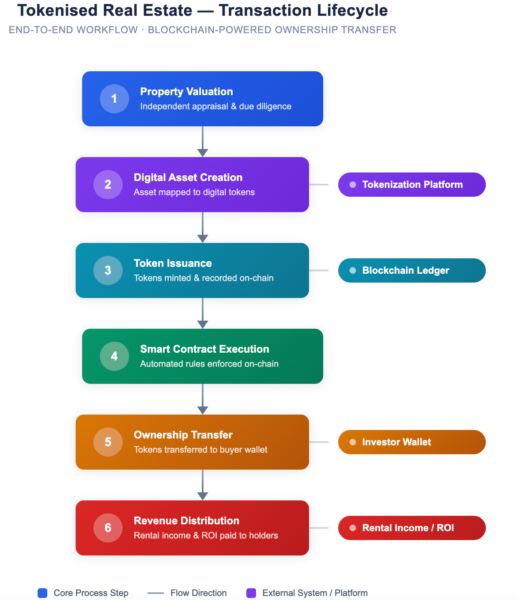
Asset Valuation: The property is appraised and converted into a digital representation.
- Token Issuance: The asset is split into digital tokens and issued on the blockchain.
- Investment: Investors purchase tokens using cryptocurrency or fiat currency.
- Ownership: The blockchain records the investor’s address as the new owner of the tokens.
- Yield: Rental income or appreciation is automatically distributed to token holders via smart contracts.
Benefits & Challenges
The Upside
- Accessibility: Global investors can participate in markets previously restricted by geography or capital.
- Transparency: Every transaction is visible on the ledger, reducing opacity and corruption risks.
- Cost Efficiency: Removing intermediaries like banks and lawyers reduces closing costs by significant margins.
- Speed: Settlement times drop from weeks to mere hours.
The Hurdles
- Regulatory Uncertainty: Laws regarding digital securities and tokenized property vary by country and are still evolving.
- Technical Complexity: The technology requires specialized knowledge to implement securely.
- Custody: Who holds the physical keys? Ensuring the security of digital wallets is critical.
Conclusion: A New Era of Ownership
The integration of blockchain real estate into the market is not just an upgrade; it is a restructuring. By enabling property tokenization, we are moving toward a system where property is treated more like a stock than a physical brick and mortar building.
While challenges regarding regulation remain, the momentum is undeniable. For real estate professionals and investors alike, understanding this technology is no longer optional—it is essential to stay competitive in a rapidly evolving landscape.
Frequently Asked Questions (FAQs)
1. What exactly is property tokenization?
Property tokenization is the process of converting the rights to a physical property into a digital token on a blockchain. This allows for fractional ownership, making it easier for multiple people to invest in real estate.
2. Is it legal to invest in tokenized real estate?
Legality depends on your jurisdiction. In many regions, tokenized securities are regulated similarly to traditional stocks. Always check the regulations in your country before investing.
3. How does tokenization increase liquidity?
In traditional real estate, selling a property can take months. Tokenized properties are traded on digital exchanges, allowing investors to sell their tokens much faster, often 24/7.
4. What are the risks involved in blockchain real estate?
Risks include market volatility, regulatory changes, technical security breaches, and the inherent risks of the underlying physical property (e.g., vacancies, structural issues).
5. Do I still need a real estate agent?
The role of the agent is changing. While physical conveyance might still require legal professionals, the transaction and matching process can be automated, potentially lowering commission fees.
6. Can foreign investors participate?
Yes, one of the biggest benefits is borderless investing. Tokenization allows international investors to purchase property stakes without navigating complex immigration or banking regulations.
7. How are rental income and profits distributed?
Smart contracts automate the distribution. When rent is collected or a property is sold, the smart contract calculates the investor’s share and instantly transfers the funds to their digital wallet.
8. Is the blockchain secure?
Blockchain technology is highly secure due to its decentralized nature and cryptographic encryption. However, the security of the specific platform or wallet used is also a factor.
9. What is the difference between a coin and a token?
A coin (like Bitcoin) usually operates on its own blockchain. A token is built on an existing blockchain (like Ethereum) and often represents an asset or utility, like a share of a property.
10. Will this replace traditional banking?
It is unlikely to replace traditional banking entirely, but it will likely disrupt mortgage lending and escrow services by offering faster, cheaper alternatives.
Stay Ahead of the Market
The landscape of real estate blockchain is moving fast. Don’t get left behind in the old ways of buying and selling property. Subscribe to our newsletter for weekly updates on property trends, investment strategies, and the latest in property tokenization news.