Ask any AML compliance officer what keeps them up at night and the answer will rarely be “we’re missing suspicious transactions.” More often, it is the opposite problem: a relentless flood of alerts that consume analyst capacity without producing meaningful outcomes. Industry data from prominent industry analysts consistently highlight that 90 to 95% of transaction monitoring alerts are false positives — legitimate transactions incorrectly flagged as suspicious. In a mid-sized bank generating 50,000 alerts per month, that means analysts are spending the vast majority of their time on transactions that will never result in a SAR filing.
Reducing AML false positives is not just an efficiency goal — it is a compliance quality goal. Every hour spent investigating a false positive is an hour not spent on a transaction that might actually warrant reporting. This playbook walks through how leading financial institutions are using machine learning to reduce AML false positives by 50 to 80%, the specific techniques that drive those results, and how to implement them in practice.
Why False Positives Are So High in Traditional AML Systems
The false positive problem in AML monitoring is structural. It is a direct consequence of how rules-based transaction monitoring systems are designed.

Rules Are Calibrated for Maximum Sensitivity
When compliance teams set alert thresholds, they face a fundamental trade-off: set thresholds too high and you miss genuine suspicious activity; set them too low and you generate excessive false positives. Regulators expect institutions to err on the side of caution — which means thresholds are typically set conservatively, guaranteeing a high false positive rate.
Rules Lack Customer Context
A wire transfer of $25,000 is unremarkable for a corporate customer who routinely makes supplier payments. The same transaction from a retail account that has never made a large international transfer is potentially significant. A threshold-based rule treats both identically. Without behavioural context, every transaction above the threshold generates an alert regardless of how consistent it is with that customer’s profile.
Siloed Detection Creates Redundant Alerts
Many institutions run separate monitoring systems for different channels — card transactions, wire transfers, ACH, and cash — each with its own rule set. A single customer whose behaviour spans channels may generate multiple alerts from each system simultaneously, all pointing to the same underlying (legitimate) activity pattern.
The Machine Learning Approach to False Positive Reduction
Machine learning reduces AML false positives through two complementary mechanisms: smarter alert generation that produces fewer low-quality alerts in the first place, and intelligent alert triage that prioritises genuinely suspicious cases for analyst review.

Mechanism 1: Behavioural Profiling to Reduce Alert Generation
Instead of flagging all transactions above a threshold, ML models build a statistical baseline of normal behaviour for each customer — accounting for transaction frequency, typical amounts, counterparty geography, payment channels, and peer group behaviour. Transactions that are consistent with the customer’s established baseline receive a low risk score; deviations receive a higher score.
This means a $25,000 wire from a corporate account that regularly makes similar transfers simply does not score highly enough to generate an alert. The alert volume drops significantly without any reduction in the detection of genuinely anomalous behaviour.
Mechanism 2: Alert Scoring and Prioritisation
Even where alerts are generated, ML models can score and rank them by the probability that they represent genuine suspicious activity. Analysts work through the highest-scoring alerts first. Low-scoring alerts — which in a pure rules-based system would receive equal treatment — are deprioritised or auto-dismissed based on configurable thresholds.
Mechanism 3: Segmentation and Peer Group Analysis
Unsupervised ML models cluster customers by behaviour profiles. When an alert is generated, the system compares the flagged transaction not just against that customer’s own history but against the behaviour of their peer group — customers with similar profiles, business types, and transaction patterns. Transactions that are unusual for the individual but normal for the peer group score lower; transactions that are unusual for both score higher.
A Practical Playbook: Eight Steps to 80% False Positive Reduction
Step 1: Baseline Your Current Performance
Before implementing any changes, document your current state precisely. Measure your alert-to-SAR conversion rate (what percentage of alerts result in a SAR filing), your false positive rate by rule, your average investigation time per alert, and total monthly alert volume by channel. These numbers become your benchmark for measuring ML impact.

Tip: most institutions find that a small number of rules — typically 10 to 20% of their rule set — generate 60 to 80% of their false positive volume. Identifying these high-offending rules is the single fastest win available before any ML implementation.
Step 2: Clean and Label Your Historical Data
Supervised ML models require labeled training data: transactions associated with confirmed SAR filings (positive examples) and confirmed legitimate transactions that were investigated and closed as not suspicious (negative examples). Audit your historical alert data for completeness and label quality before attempting to train any model.
Warning: imbalanced datasets — where genuine suspicious activity represents 1 to 5% of labeled examples — require specific handling techniques (oversampling, synthetic data generation, cost-sensitive learning) to prevent the model from simply learning to predict “not suspicious” for everything.
Step 3: Build Customer Behavioural Profiles
Construct rolling statistical profiles for each customer covering a minimum of 90 days of history. Key features to include:
- Average transaction amount and standard deviation by channel
- Typical transaction frequency (daily, weekly, monthly patterns)
- Geographic distribution of counterparties
- Time-of-day and day-of-week patterns
- Counterparty concentration (how many unique counterparties, how often repeat)
- Cash vs electronic payment ratio
Step 4: Implement Peer Group Segmentation
Use unsupervised clustering (K-means, DBSCAN, or hierarchical clustering) to group customers by behaviour profile. Aim for granular segments — a “small business retail payments” cluster behaves very differently from a “freelancer international transfers” cluster, even if both are individual account holders. Alerts from customers whose transaction is consistent with their peer group should receive automatic score reductions.
Step 5: Deploy a Supervised Scoring Model
Train a gradient boosting model (XGBoost or LightGBM are standard choices for tabular transaction data) on your labeled historical alert data. Features should include the customer behavioural profile features above, plus transaction-level features: amount, channel, counterparty risk score, time since last transaction, and deviation from the customer’s own baseline.
Validate the model on a held-out test set. Key metrics to track: precision and recall at your chosen score threshold, the AUC-ROC curve, and — most importantly — the false positive rate at the threshold where your true positive rate (genuine SAR rate) is maintained at or above current levels.
Step 6: Run in Parallel for 90 Days
Do not replace your existing rules immediately. Run the ML scoring model in parallel alongside your current system for a minimum of 90 days. During this period, compare ML scores against rule-triggered alerts. Identify where the model agrees with your rules, where it disagrees, and — critically — whether the model correctly identifies the genuine suspicious cases that your rules catch.
This parallel run period also builds the evidence base you will need to satisfy your model risk management team and, potentially, your regulator.
Step 7: Implement Auto-Dismissal with Governance Controls
Once model performance is validated, implement auto-dismissal for alerts below a defined ML score threshold. Start conservatively — auto-dismiss only alerts in the bottom 20 to 30% of scores initially — and expand as confidence builds. Document every auto-dismissal decision, retain full audit trails, and implement a regular sample review process where analysts review a random sample of auto-dismissed alerts to verify the model is not suppressing genuine suspicious activity.
Step 8: Establish Model Monitoring and Retraining Cadence
ML models degrade over time as customer behaviour and laundering typologies evolve. Implement ongoing performance monitoring: track your false positive rate, SAR conversion rate, and model score distributions on a monthly basis. Schedule model retraining on a quarterly or semi-annual cycle using updated labeled data. Set automated alerts for significant model drift — defined as a meaningful change in score distribution or a drop in SAR conversion rate.
False Positive Reduction Results: What Institutions Have Achieved

| Institution / Context | Approach | False Positive Reduction | Source |
|---|---|---|---|
| HSBC (global) | AI transaction monitoring with Google Cloud | ~60% | Google Cloud case study, 2023 |
| ING Bank (Europe) | ML behavioural profiling, multi-market rollout | Significant reduction reported across markets | public statements |
| Mid-size US bank (anonymised) | Gradient boosting scoring overlay on rules | 74% over 12 months | public statement |
| European fintech (anonymised) | API-based ML monitoring (ComplyAdvantage) | 68% within 6 months | public statement |
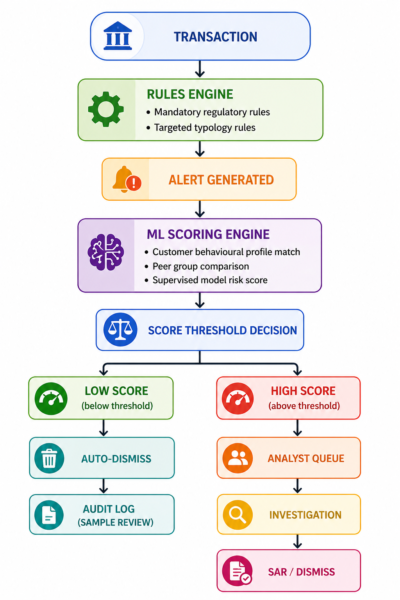
ML-Driven False Positive Reduction: Process Flow
The process begins when a transaction enters the Rules Engine, which applies mandatory regulatory rules and targeted typology rules to generate an initial alert. Each alert then passes through an ML Scoring Engine that evaluates it against the customer’s behavioural profile, peer group benchmarks, and a supervised model risk score. Based on the resulting score, alerts are routed at a threshold decision point: low-score alerts are auto-dismissed and retained in an audit log with sample review for assurance, while high-score alerts are escalated to the analyst queue for full investigation, ultimately resulting in either a Suspicious Activity Report (SAR) filing or dismissal.
Regulatory Considerations: What You Must Document
Regulators broadly support ML-based false positive reduction, but they expect institutions to demonstrate that the approach does not suppress genuine suspicious activity. The documentation requirements are clear:
- Model validation: independent validation of the ML model by a team separate from the development team, covering conceptual soundness, data quality, and performance testing
- Auto-dismissal audit trail: complete records of every alert suppressed by the ML scoring engine, retained for the standard regulatory period
- Sample review results: documented outcomes from periodic analyst reviews of auto-dismissed alerts
- Performance monitoring reports: monthly or quarterly reports showing model performance metrics, false positive rates, and SAR conversion rates
- Change management log: records of any model updates, threshold changes, or retraining events
Frequently Asked Questions
What causes high false positive rates in AML transaction monitoring?
High false positive rates result primarily from rules-based systems with static thresholds that lack customer context. Rules calibrated conservatively to avoid missing suspicious activity inevitably flag large volumes of legitimate transactions. The absence of behavioural profiling means every transaction above a threshold generates an alert, regardless of how consistent it is with that customer’s normal behaviour.
How does machine learning reduce AML false positives?
ML reduces false positives through behavioural profiling (scoring transactions against each customer’s established baseline), peer group analysis (comparing against similar customers), and supervised scoring models trained on labeled SAR data. Transactions consistent with normal behaviour score low and can be auto-dismissed; only genuinely anomalous transactions reach analysts.
What is a good AML false positive rate?
Industry benchmarks suggest that best-in-class AML programmes achieve false positive rates below 50% — meaning fewer than half of alerts require investigation before dismissal. Institutions using mature ML monitoring often report rates below 30%. The starting point for most rules-based institutions is 90 to 95%, making even a 50% reduction a significant operational improvement.
Is auto-dismissal of AML alerts compliant with regulations?
Yes, provided it is implemented with appropriate governance: a validated ML model, full audit logging of dismissed alerts, a documented sample review process, and clear escalation procedures. Regulators in the US, UK, and EU have accepted ML-based alert suppression where institutions can demonstrate the model does not suppress genuine suspicious activity.
How long does it take to implement ML false positive reduction?
A typical implementation timeline is 6 to 12 months from project start to production deployment with auto-dismissal active. This includes data preparation and labeling (2 to 3 months), model development and validation (2 to 3 months), parallel running and governance sign-off (3 months), and phased rollout. Vendor API solutions can compress this significantly.
What ML models work best for AML false positive reduction?
Gradient boosting models (XGBoost, LightGBM) are the most widely used for alert scoring on tabular transaction data. Unsupervised clustering models (K-means, DBSCAN) work well for peer group segmentation. Neural networks can achieve higher accuracy but require more data and are harder to explain to regulators. Most production implementations use gradient boosting for its combination of performance and explainability.
What data is needed to train an AML false positive reduction model?
Minimum requirements include 12 to 24 months of transaction history, labeled historical alerts (confirmed SAR filings and confirmed legitimate closures), customer profile data, and channel metadata. Higher data quality and volume produce better models. Institutions with fewer than 1,000 confirmed SAR examples may need to supplement with synthetic data or use unsupervised approaches initially.
How do you validate an ML model for AML compliance?
Model validation for AML compliance follows the SR 11-7 framework: independent review of conceptual soundness, data quality assessment, performance testing on held-out data, comparison against the benchmark (existing rules system), sensitivity analysis, and documentation of limitations. The validation team must be independent of the development team.
What is model drift in AML and how do you manage it?
Model drift occurs when the statistical relationships a model learned during training no longer accurately represent current data — for example, because customer behaviour has changed or new laundering typologies have emerged. Manage it through monthly monitoring of score distributions and SAR conversion rates, quarterly review meetings, and semi-annual retraining on updated labeled data.
Can small banks reduce AML false positives with machine learning?
Yes. Cloud-based, API-delivered AML platforms from vendors like ComplyAdvantage, Unit21, and Sardine provide pre-trained ML models that community banks and fintechs can deploy without building in-house data science capability. These platforms leverage training data across their entire client base, giving smaller institutions access to models trained on far more data than they could generate independently.
Conclusion
Reducing AML false positives by 80% is not a theoretical target — it is a result that documented implementations at HSBC and other institutions have achieved in production. The path to that outcome follows a clear sequence: baseline your current performance, clean and label your historical data, build customer behavioural profiles, layer in peer group segmentation, deploy a validated scoring model, run in parallel, implement governed auto-dismissal, and monitor continuously.
The operational and compliance benefits compound over time. Every percentage point reduction in false positives returns analyst capacity to genuine investigations, improves SAR quality, reduces regulatory risk, and lowers the cost of your compliance programme. For institutions still running purely rules-based monitoring, the question in 2026 is no longer whether to adopt ML for false positive reduction — it is how quickly you can do it responsibly.
Subscribe to the PetaFusion newsletter for implementation guides, technology benchmarks, and practical frameworks for modernising your AML compliance programme with machine learning.