Financial institutions spent an estimated $274 billion on financial crime compliance in 2022, according to LexisNexis Risk Solutions. A significant portion of that cost flows directly into transaction monitoring operations — the armies of analysts reviewing alerts, the technology platforms generating them, and the regulatory overhead of filing Suspicious Activity Reports. Yet for all that spend, the system catches only a fraction of the money laundering that actually occurs. Estimates from the United Nations Office on Drugs and Crime suggest less than 1% of illicit funds are seized globally each year.
The core question facing compliance leaders in 2026 is whether rule-based vs AI AML approaches represent a genuine fork in the road — or whether the answer is a hybrid model that combines the strengths of both. This article breaks down how each approach works, where each excels and falls short, and what the evidence says about which one actually catches money launderers in practice.
How Rule-Based Transaction Monitoring Works

Rule-based transaction monitoring is the dominant approach in use today. At its heart, it is straightforward: compliance teams define threshold-based rules that flag transactions meeting certain criteria. When a transaction matches a rule, it generates an alert that enters a review queue.
Common Rule Structures
- Cash transactions exceeding $10,000 (CTR threshold triggers in the US)
- Multiple transactions just below reporting thresholds within a defined window (structuring detection)
- Wire transfers to or from high-risk jurisdictions above a set value
- Rapid movement of funds across accounts within 24 to 48 hours
- Transactions inconsistent with a customer’s declared business type or income level
How Rules Are Defined and Maintained
Rules are typically built by a combination of compliance officers, technology teams, and external consultants. They are calibrated against known money laundering typologies — either drawn from regulatory guidance, internal SAR history, or industry bodies like the Financial Action Task Force (FATF). Once live, rules require ongoing tuning: thresholds are adjusted when false positive rates climb, and new rules are added as new typologies are identified.
The Core Weakness: Static Logic in a Dynamic Environment
The fundamental problem with rules is that they are binary and static. A transaction either meets the threshold or it does not. There is no concept of context, customer history, or relationship between transactions. A money launderer who understands your rules — and sophisticated criminal networks do — can engineer transactions that stay just outside every threshold indefinitely.
How AI-Based Transaction Monitoring Works

AI-based, or machine learning AML, replaces static rules with statistical models trained on historical transaction data. These models learn what legitimate customer behaviour looks like and flag deviations — rather than checking whether a transaction crossed a fixed line.
The Machine Learning Approaches in Use
- Supervised learning: trained on labeled datasets of confirmed SAR filings and confirmed legitimate transactions, producing a probability score that a given transaction is suspicious
- Unsupervised learning: clusters customers and transactions by behaviour patterns without predefined labels — anomalies that fall outside any cluster are flagged for review
- Graph analytics: maps the full network of relationships between accounts, entities, and transactions, detecting layering and structuring across multiple parties simultaneously
- Natural language processing: analyses transaction narratives, wire instructions, and payment references for suspicious terminology or patterns
Behavioural Baseline: The Key Difference
Rather than asking “did this transaction cross a threshold?”, an ML model asks “is this transaction consistent with everything we know about this customer’s history, peer group, and declared profile?” The risk score reflects context — the same transaction value generates a different score for a corporate customer with a history of regular large transfers versus a retail account with no prior activity.
Rule-Based vs AI AML: Head-to-Head Comparison

| Dimension | Rule-Based | AI-Based |
|---|---|---|
| Detection approach | Threshold-based: flag if rule is met | Risk-scoring: flag if behaviour deviates from baseline |
| False positive rate | 90 to 95% of alerts are false positives (industry average) | 50 to 80% false positive reduction in documented deployments |
| Novel typology detection | Cannot detect what has not been encoded as a rule | Detects emerging patterns through anomaly detection |
| Explainability | Fully explainable: a specific rule was triggered | Variable: some models explain well, others are black boxes |
| Regulatory acceptance | Well established, regulators understand and accept | Broadly accepted with model governance requirements |
| Maintenance burden | High: rules require constant tuning and typology updates | Lower: models retrain periodically on new data |
| Data requirements | Minimal: works on transaction data alone | Significant: requires labeled historical data for training |
| Speed to deploy | Fast: new rules can be live within days | Slower: model training, validation, and testing required |
| Cross-channel detection | Weak: typically siloed by payment channel | Strong: graph models span channels and entities natively |
| Cost | Lower upfront, higher operational cost (analyst time) | Higher upfront investment, lower ongoing operational cost |
Where Rule-Based Monitoring Still Wins

Rules are not obsolete. There are specific contexts where they remain the right tool.
Regulatory Mandatory Reporting
Currency Transaction Reports (CTRs) in the US, and equivalent mandatory reports in other jurisdictions, are threshold-driven by law. A rule that flags cash transactions above $10,000 is not optional — it is a legal requirement. AI models cannot and should not replace these mandatory rule triggers.
Known, Stable Typologies
Where a money laundering typology is well understood, consistently structured, and unlikely to evolve, a simple rule is often more reliable than an ML model. Structuring (deliberately breaking transactions into amounts below reporting thresholds) is a good example — it follows a predictable pattern that rules can encode precisely.
Auditability in Regulated Environments
When a regulator asks why a specific transaction was flagged, “because Rule 47 was triggered” is a clean, defensible answer. In jurisdictions or institutions where model risk management capabilities are immature, rules provide a level of auditability that ML models must work harder to match.
Where AI-Based Monitoring Clearly Outperforms
Complex, Multi-Party Laundering Schemes
Trade-based money laundering, money mule networks, and layering schemes spread across dozens of accounts are almost impossible to detect with per-transaction rules. Graph analytics models, which map the full relationship network and identify suspicious flow patterns across entities, are the only scalable solution to these typologies.
Reducing Analyst Workload
The operational cost of a 95% false positive rate is enormous. HSBC’s AI implementation reduced false positives by approximately 60% — effectively doubling the productive capacity of its compliance team without adding headcount. For institutions facing budget pressure and talent shortages, this is the most immediately compelling argument for AI.
Real-Time Detection
ML models scoring transactions in under 100 milliseconds can integrate into payment authorisation flows — blocking or holding high-risk transactions before settlement. Rules-based systems running in batch cycles after the fact cannot prevent the movement of funds; they can only detect it after the fact. For real-time payment schemes like FedNow and SEPA Instant, real-time machine learning transaction monitoring is increasingly a practical necessity.
The Case for a Hybrid AML Model
The most effective AML transaction monitoring architectures in 2026 are not purely rule-based or purely AI — they are hybrid, combining both in a layered approach that uses each where it performs best.
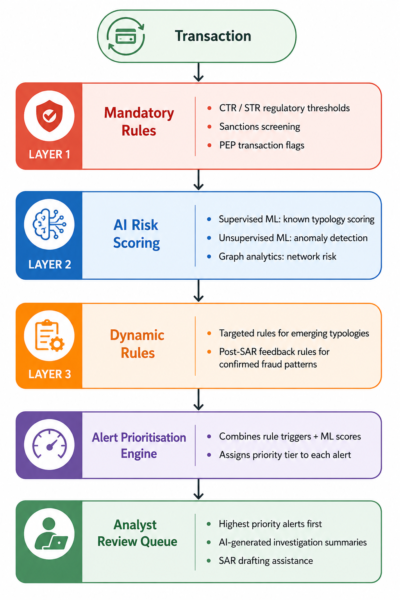
In a well-designed hybrid model, mandatory rules handle regulatory compliance, ML models handle pattern recognition and false positive reduction, and targeted rules catch emerging typologies identified by compliance teams or industry intelligence. The alert prioritisation engine combines signals from all layers, ensuring analysts spend time on the highest-risk cases.
Real-World Evidence: What the Data Shows
Global Banks are investing in AI transaction monitoring deployment, developed in partnership with AI & Cloud technology providers, achieved a significant reduction in false positives while improving genuine SAR detection rates. The institution retained its mandatory rules layer but replaced the bulk of discretionary threshold-based rules with ML scoring models. This is now a widely cited benchmark in the industry.
Smaller Institutions: API-First Vendors
Community banks and fintechs adopting cloud-based AI AML platforms from vendors like ComplyAdvantage and Featurespace have consistently reported false positive reductions of 40 to 70% with no increase in genuine SAR miss rates. The barrier to AI-powered monitoring has dropped significantly as these platforms matured.
Frequently Asked Questions
What is the main difference between rule-based and AI-based AML monitoring?
Rule-based monitoring flags transactions that cross predefined thresholds — it is static and binary. AI-based monitoring builds a behavioural baseline for each customer and flags deviations, producing context-aware risk scores that dramatically reduce false positives while detecting patterns that rules cannot encode.
What is a false positive in AML transaction monitoring?
A false positive is an alert generated by the monitoring system that, upon investigation, turns out to involve a legitimate transaction. Industry data consistently shows that 90 to 95% of alerts from rules-based systems are false positives, consuming enormous compliance resources with no investigative output.
Can AI replace rules in AML monitoring entirely?
No. Mandatory regulatory reporting requirements — such as Currency Transaction Reports for cash transactions above $10,000 — are threshold-based by law and cannot be replaced by AI. The most effective approach is a hybrid model that uses mandatory rules for regulatory compliance and AI for risk scoring and anomaly detection.
What is a hybrid AML model?
A hybrid AML model combines rule-based and AI-based monitoring in a layered architecture. Mandatory rules handle regulatory reporting triggers, ML models provide risk scoring and anomaly detection, and targeted rules address specific emerging typologies. An alert prioritisation engine combines signals from all layers into a ranked review queue.
How much can AI reduce false positives in AML?
Documented implementations at major institutions including HSBC have achieved 50 to 80% false positive reductions. The precise outcome depends on data quality, model design, and how well the ML models are calibrated against the institution’s specific customer population and transaction mix.
What is machine learning transaction monitoring?
Machine learning transaction monitoring uses ML models trained on historical transaction data to produce real-time risk scores for each transaction. The models learn what normal behaviour looks like for each customer and flag deviations, rather than checking whether fixed thresholds have been breached. This approach adapts to new laundering patterns as they emerge.
Is AI-based AML monitoring accepted by regulators?
Yes. FinCEN, the FCA, the EBA, and other major financial regulators broadly support AI adoption in AML provided institutions demonstrate model governance, explainability, and ongoing performance monitoring. Model risk management requirements under frameworks like SR 11-7 apply to AI models as they do to any quantitative risk model.
What is graph analytics in AML?
Graph analytics maps the relationships between accounts, entities, and transactions as a network of interconnected nodes. In AML, this reveals money mule networks, layering schemes, and circular fund flows that involve multiple parties — patterns that per-transaction rules simply cannot detect because they only evaluate one transaction at a time.
Which is more expensive: rule-based or AI-based AML monitoring?
Rule-based systems typically have lower upfront costs but higher ongoing operational costs due to the analyst resources required to investigate the high volume of false positive alerts they generate. AI-based systems require greater upfront investment in data, technology, and model validation but typically reduce operational costs significantly over time through false positive reduction.
What is a false positive reduction in AML?
False positive reduction refers to decreasing the percentage of alerts that turn out to involve legitimate transactions. Reducing false positives directly reduces the analyst workload, improves the quality of SAR filings, and lowers the cost per genuine suspicious activity identified. AI transaction monitoring is the primary technology lever for achieving meaningful false positive reduction at scale.
What are the best AI tools for AML transaction monitoring?
Leading platforms include Featurespace (ARIC Risk Hub), NICE Actimize (AI-powered transaction monitoring), Quantexa (graph analytics and entity resolution), ComplyAdvantage (real-time ML risk screening), and Sardine (API-first ML monitoring for fintechs). Tier-one banks often combine vendor platforms with in-house ML development.
Conclusion
The debate between rule-based vs AI AML is less a competition and more an evolution. Rules earned their place in the compliance arsenal and continue to fulfil critical regulatory functions that AI cannot replace. But the evidence is unambiguous that rules alone — generating false positive rates above 90%, missing novel typologies, and failing to see across channels and entities — are insufficient for the scale and sophistication of financial crime in 2026.
The institutions catching the most money launderers today are not the ones with the most rules. They are the ones that have built hybrid architectures where AI and rules reinforce each other, with ML models dramatically sharpening the signal, and mandatory rules ensuring regulatory obligations are met without exception.
If you are evaluating your institution’s AML monitoring strategy, the practical starting point is not replacing rules with AI — it is identifying the rules generating the highest false positive volumes and piloting ML scoring as an overlay. That single step typically delivers visible results within the first quarter.
Subscribe to the PetaFusion newsletter for ongoing coverage of AI in financial crime compliance, AML technology benchmarks, and practical RegTech implementation guides.