Banks and financial institutions filed 3.6 million Suspicious Activity Reports (SARs) in the United States alone in 2023, according to FinCEN data. Yet estimates suggest only 1 in 100 of those reports leads to a meaningful law enforcement outcome. The gap between detection and prosecution is staggering — and much of it comes down to how transaction monitoring has been done for the past three decades: static rules, manual review queues, and alert fatigue on a massive scale.
AI transaction monitoring is changing that equation in 2026. Machine learning models now process millions of transactions in milliseconds, adapt to emerging typologies without manual rule updates, and surface genuinely suspicious patterns that rules-based engines consistently miss. This article breaks down exactly how AI is reshaping AML compliance — what it fixes, what it does not, and what financial institutions need to know to navigate the shift.
The Problem with Traditional Rules-Based AML Monitoring

Traditional transaction monitoring systems operate on a simple logic: define a rule, set a threshold, and flag anything that crosses it. A customer moves more than $10,000 in a single transaction — flag it. Transfers to a high-risk jurisdiction exceed a monthly limit — flag it.
On paper, it sounds reasonable. In practice, it creates three persistent problems.
The False Positive Crisis
Rules calibrated broadly enough to catch real money laundering also catch enormous volumes of legitimate activity. Industry benchmarks from KPMG and Deloitte consistently show that 90 to 95% of transaction monitoring alerts are false positives. Compliance teams spend enormous resources investigating transactions that go nowhere — a direct drag on operations and a hidden cost that runs into millions annually for mid-sized institutions.
Static Rules Cannot Keep Up with Dynamic Criminals
Money laundering typologies evolve constantly. Trade-based money laundering, crypto layering, structuring via multiple accounts, and synthetic identity fraud all have one thing in common: they are designed specifically to stay below the thresholds that existing rules target. By the time compliance teams identify a new typology and encode a rule to catch it, criminals have already moved on.
Siloed Transaction Data
Traditional systems typically monitor individual channels in isolation — cards, wire transfers, and ACH transactions reviewed separately. Money launderers routinely exploit these silos, spreading activity across channels, accounts, and institutions in ways that look innocent on any single ledger but tell a clear story in aggregate.
How AI Transaction Monitoring Works in 2026

Modern AI-powered AML systems replace static rule engines with adaptive machine learning models trained on historical transaction data — both confirmed suspicious activity and confirmed legitimate behaviour. The result is a system that learns what normal looks like for each customer and flags deviations, not just threshold breaches.
The Core Machine Learning Approaches
| Approach | How It Works | Primary AML Application |
|---|---|---|
| Supervised Learning | Trained on labeled data (known SAR filings, confirmed fraud cases) | Scoring transactions against known fraud patterns |
| Unsupervised Learning | Identifies anomalies without predefined labels | Detecting novel typologies, unusual peer group deviations |
| Graph Analytics | Maps relationships between accounts, entities, and transactions | Network analysis for complex layering schemes |
| Natural Language Processing | Parses transaction narratives and wire instructions | Trade finance monitoring, sanctions screening |
| Generative AI / LLMs | Synthesises investigation narratives and SAR drafts | Alert disposition support and SAR automation |
Behavioural Profiling: The Key Shift
The most important concept in machine learning AML is behavioural profiling. Instead of asking “did this transaction cross a threshold?”, AI systems ask “is this transaction consistent with what we know about this customer?”
A $50,000 wire transfer might be completely unremarkable for a corporate treasurer managing routine supplier payments. The same transfer from a retail customer with no history of large international wires would generate a very high risk score. Rules treat both the same. ML models do not.
Real-Time Transaction Monitoring: Why Speed Matters

Real-time transaction monitoring is not just a performance upgrade — it is a fundamentally different capability. Batch-based monitoring (reviewing transactions in daily or hourly cycles) means that by the time a suspicious transfer is flagged, the funds may already be layered through multiple accounts and effectively unrecoverable.
AI-powered real-time monitoring can:
- Score transactions in under 100 milliseconds during payment authorisation
- Block or hold high-risk transactions before settlement, not after
- Feed back real-time intelligence to update risk models continuously
- Integrate sanctions screening and PEP checks within the same processing window
For payment processors and fintech platforms operating at scale, this shift from detective to preventive controls represents a major compliance maturity leap.
Real-World Use Cases: AI AML in Action

Global Banks: Reducing Alert Volume
HSBC partnered with Google Cloud in 2023 to deploy an AI-powered transaction monitoring system. The implementation reduced false positives by approximately 60% while simultaneously improving detection rates for genuine suspicious activity. Investigators could focus on cases that actually warranted attention, dramatically improving SAR quality.
FinTechs: Building Compliance into the Product
Challenger banks and payment platforms face a paradox: they need sophisticated AML capabilities but lack the compliance headcount of tier-one banks. AI platforms like ComplyAdvantage, Featurespace, and Sardine provide next-gen AML capabilities as modular APIs — allowing fintechs to deploy production-grade ML monitoring without building it in-house.
Payment Processors: Cross-Channel Detection at Scale
Visa and Mastercard both operate AI-based transaction monitoring that crosses card networks, merchant categories, and geographies simultaneously. Visa’s AI risk engine processes over 76,000 transactions per second, with ML models generating real-time risk scores for each one — a volume that no rules-based system could reliably interrogate at that speed.
Benefits vs Challenges: An Honest Assessment

| Benefits | Challenges |
|---|---|
| 50 to 80% false positive reduction achievable in documented deployments | Model explainability required by regulators — black-box decisions are a compliance risk |
| Adapts to new typologies without manual rule updates | Requires high-quality, well-labeled training data — a challenge for smaller institutions |
| Real-time detection enables preventive, not just detective, controls | Model drift requires continuous monitoring and periodic retraining |
| Cross-channel, cross-entity visibility via graph analytics | Integration complexity with legacy core banking and payment systems |
| Generative AI accelerates SAR drafting and investigation workflows | Regulatory frameworks for AI in AML are still evolving across jurisdictions |
| Scales efficiently to handle transaction volumes that overwhelm rules engines | Initial implementation cost and change management can be significant |
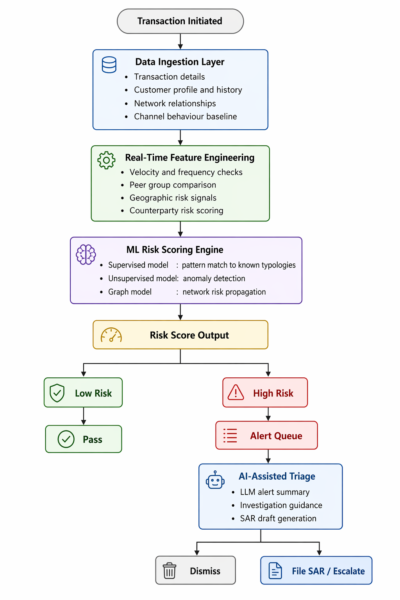
An ideal AI-Powered AML Transaction Monitoring Process Flow
The diagram below shows how a modern AI transaction monitoring pipeline operates from transaction initiation through to final disposition and SAR filing.
The Regulatory Dimension: What Compliance Teams Must Know
Regulator Expectations in 2026
Financial regulators across the US, UK, and EU have broadly encouraged AI adoption in AML while establishing clear expectations around model governance and auditability. The Financial Crimes Enforcement Network (FinCEN) issued a statement as early as 2018 supporting innovation in AML technology, and subsequent guidance has continued to back AI-driven approaches — provided institutions can document model logic, validation processes, and performance outcomes.
Model Risk Management Under SR 11-7
Under SR 11-7 — the Federal Reserve and OCC’s supervisory guidance on model risk management — AI transaction monitoring models carry the same governance requirements as credit risk models. Independent validation, ongoing performance monitoring, and documented conceptual soundness are non-negotiable. Institutions deploying ML for AML need to ensure their model risk frameworks are fully extended to cover these new systems, including bias testing and performance benchmarking against the legacy rules they replaced.
How to Implement AI Transaction Monitoring: A Practical Roadmap
- Baseline your current performance. Before replacing or supplementing rules-based monitoring, document your false positive rate, alert-to-SAR conversion rate, and average investigation time. These benchmarks will measure AI impact objectively.
- Assess data quality and availability. ML models are only as good as their training data. Audit your transaction records for completeness, consistency, and historical depth — ideally three or more years of labeled activity.
- Choose your deployment approach. Vendor platforms such as NICE Actimize, Quantexa, and Featurespace offer faster time-to-value. In-house development provides greater control but demands significant data science capability and longer lead times.
- Run parallel for 90 days. Operate AI models alongside existing rules before cutting over. Use the parallel period to tune thresholds, validate performance, and build investigator familiarity with the new system.
- Engage your regulator early. Share your AI implementation plans and validation methodology with your primary supervisor proactively. Regulators consistently respond more positively to prior engagement than to post-hoc explanations.
- Embed explainability from day one. Choose models and tooling that produce human-readable explanations for each alert — not just a risk score. Both investigators and regulators need to understand why a specific transaction was flagged.
Frequently Asked Questions
What is AI transaction monitoring in AML?
AI transaction monitoring uses machine learning and advanced analytics to identify potentially suspicious financial activity in real time. Unlike traditional rules-based systems, AI models learn from historical data to detect unusual patterns, reduce false positives, and adapt to new money laundering typologies without requiring manual rule updates.
How is machine learning different from rules-based AML monitoring?
Rules-based systems flag transactions that breach predefined thresholds — a fixed, static approach. Machine learning models build behavioural profiles for individual customers and flag deviations from established norms, producing context-aware risk scores that dramatically reduce false positives while improving detection of novel laundering patterns.
What is real-time transaction monitoring and why does it matter for AML?
Real-time transaction monitoring scores and analyses transactions as they occur — typically in under 100 milliseconds — rather than in batch cycles hours later. This enables financial institutions to block or hold suspicious transactions before settlement, shifting AML controls from detective to preventive and significantly improving the chance of recovering funds.
What AI tools are leading AML compliance in 2026?
Leading AI tools include graph analytics platforms (Quantexa, Neo4j), ML transaction monitoring engines (Featurespace, NICE Actimize), entity risk scoring (ComplyAdvantage, LexisNexis Risk Solutions), and generative AI tools for SAR drafting. Most tier-one banks combine in-house and vendor AI capabilities tailored to their technology stack.
Can smaller banks and fintechs afford AI-powered AML monitoring?
Yes. The growth of modular, API-delivered AML platforms has made AI transaction monitoring accessible to institutions of all sizes. Vendors like Sardine, ComplyAdvantage, and Unit21 offer cloud-based ML monitoring priced for community banks and fintechs, removing the need for large in-house data science teams.
How do financial regulators view AI in AML?
Major regulators including FinCEN, the FCA, and EBA broadly support AI adoption in AML provided institutions can demonstrate model governance, explainability, and ongoing performance monitoring. Model risk management frameworks such as SR 11-7 apply to AI models, requiring independent validation and documented conceptual soundness.
What is the false positive problem in AML and how does AI address it?
Studies from KPMG and Deloitte show that 90 to 95% of rules-based transaction monitoring alerts are false positives. AI models reduce this significantly — typically 50 to 80% in documented implementations — by generating context-aware risk scores based on individual customer behaviour rather than generic thresholds.
What is graph analytics and how is it used in AML?
Graph analytics maps relationships between accounts, entities, and transactions as interconnected nodes and edges. In AML, this reveals not just individual suspicious transactions but the full network of connected parties — essential for detecting layering schemes and money mule networks that span multiple accounts or institutions.
Is AI replacing AML compliance analysts?
No. AI is augmenting analysts, not replacing them. By reducing false positive alert volumes and providing AI-generated investigation summaries, analysts spend more time on genuinely suspicious cases and higher-quality SAR filing. The role is evolving from manual alert reviewer to complex financial crime investigation specialist.
What is model drift and why does it matter in AML?
Model drift occurs when the statistical patterns an ML model was trained on shift over time — for example, as customer behaviour evolves or new laundering typologies emerge. Unmonitored drift can cause a previously effective model to degrade silently. Robust monitoring, periodic retraining, and performance benchmarking against current SARs are essential safeguards.
How does generative AI support AML investigations?
Generative AI and large language models are increasingly used to automate SAR narrative drafting, synthesise alert investigation summaries, and guide analysts through investigation steps. This reduces average investigation time and improves consistency in SAR quality across large compliance teams — freeing analysts for work that requires genuine human judgment.
Conclusion
The case for AI transaction monitoring in AML is no longer theoretical — it is backed by documented results from some of the world’s largest financial institutions. False positive rates are falling, genuine detection is improving, and real-time capabilities are moving compliance from a reactive, detective function to genuine financial crime prevention.
The transition will not be without challenges: data quality, model governance, regulatory engagement, and change management are all real constraints that require careful planning. But financial institutions that delay the shift risk falling behind — both in compliance effectiveness and in the operational efficiency that modern AML demands.
In 2026, the question is no longer whether to adopt machine learning AML. It is how fast and how well you can do it. The institutions moving quickly and thoughtfully on this are building a compliance capability that is genuinely fit for the threat environment they face.
If you found this article useful, subscribe to the PetaFusion newsletter for regular deep-dives on AI in financial crime compliance, RegTech innovation, and AML best practices delivered directly to your inbox.