Every bank account opened, every loan approved, every payment account created starts with the same question: who is this person, really? KYC compliance — Know Your Customer — is the process financial institutions use to answer that question with confidence. It is one of the most important obligations in banking, and one of the most misunderstood. Get it wrong and you face regulatory action, reputational damage, and potential liability for facilitating financial crime. Get it right and it becomes the foundation of everything else in your AML programme.
This guide walks through the complete KYC process in banking — from the regulatory basis to the practical steps of identity verification, risk rating, and ongoing monitoring — with clear explanations, real-world context, and a step-by-step framework you can apply directly to your compliance programme.
What Is KYC Compliance?
KYC compliance is the set of policies, procedures, and controls a financial institution maintains to verify the identity of its customers, understand the nature of their financial relationships, and assess the risk they present for money laundering, terrorist financing, and other financial crime.

KYC is not a single check performed once at account opening. It is an ongoing process that runs throughout the customer lifecycle — from the first identity verification at onboarding through periodic reviews, trigger-based refreshes, and continuous transaction monitoring. A customer whose risk profile changes significantly after onboarding must have their KYC file updated to reflect the new reality.
The Regulatory Basis for KYC
In the United States, KYC requirements derive from the Bank Secrecy Act (BSA) and FinCEN’s implementing regulations, including:
- The Customer Identification Programme (CIP) Rule (31 CFR 1020.220): requires banks to collect and verify identity information for all new account holders
- The Customer Due Diligence (CDD) Rule (2018): requires understanding the nature and purpose of customer relationships and identifying beneficial owners of legal entity customers
- The Anti-Money Laundering Act of 2020: expanded beneficial ownership requirements through the Corporate Transparency Act
Internationally, KYC requirements are grounded in FATF Recommendations 10-12, which mandate Customer Due Diligence, record keeping, and Enhanced Due Diligence for Politically Exposed Persons. The EU’s AML Regulation (AMLR) harmonises these requirements across member states as of 2026.
The Five Stages of the KYC Process in Banking
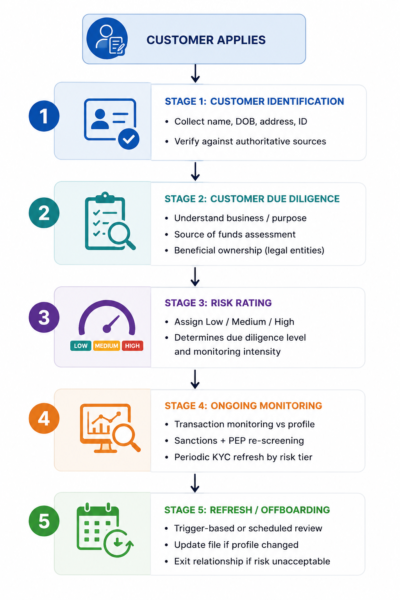
Stage 1: Customer Identification — Collecting and Verifying Identity
The Customer Identification Programme (CIP) is the entry point. Before any account is opened or relationship established, the institution must collect and verify four minimum data elements for individual customers:
- Full legal name
- Date of birth
- Residential address (or business address for entities)
- Identification number (Social Security Number for US persons; passport or national ID number for non-US persons)
Verification must go beyond simply collecting documents — the institution must confirm they are genuine and belong to the person presenting them. Acceptable verification methods include:
- Documentary verification: government-issued photo ID (passport, driver’s licence, national ID card)
- Non-documentary verification: checking against credit bureau records, public databases, or third-party identity verification services
- Digital/biometric verification: automated document scanning combined with facial biometric matching against the ID photo
Stage 2: Customer Due Diligence — Understanding Who You Are Dealing With
CIP tells you who the customer is. CDD tells you what they do, why they want to bank with you, and what their transactions should look like. This context is essential for making transaction monitoring meaningful rather than mechanical.
Standard CDD for individual customers covers:
- Occupation and employer
- Source of funds (salary, business income, investment proceeds)
- Purpose and expected nature of the banking relationship
- Expected transaction volumes and values
- Geographic connections (countries of residence, business, or regular transactions)
For corporate customers, CDD extends significantly further:
- Nature of the business, products/services, customer base, and geographic footprint
- Ownership structure and Ultimate Beneficial Owners (UBOs) — individuals owning 25% or more
- Directors, authorised signatories, and controlling persons
- Source of business funds and expected cash flow patterns
- Regulatory licences and registrations relevant to the business type
Stage 3: Risk Rating — Calibrating Your Response
Risk rating is the output of CDD. It translates everything you know about the customer into a structured assessment of the financial crime risk they present — and drives every downstream decision about how intensively that customer is monitored and how frequently their KYC is reviewed.
| Risk Factor | Low Risk Indicators | High Risk Indicators |
|---|---|---|
| Geography | Resident in low-risk jurisdiction; domestic transactions only | Resident in or transacting with FATF grey/black list countries; high-risk jurisdictions |
| Customer type | Employed individual; established local business | PEP or PEP associate; cash-intensive business; VASP; NGO in high-risk region |
| Ownership structure | Simple, transparent ownership; listed company | Complex multi-layer structure; nominee directors; secrecy jurisdiction registration |
| Products/channels | Standard retail products; branch-based relationship | Private banking; correspondent banking; virtual assets; high-value cash products |
| Transaction profile | Consistent, predictable patterns; salary and routine payments | Unexplained large transactions; frequent international wires; cash-heavy activity |
| Adverse media | No negative news | Linked to financial crime, corruption, or sanctions investigations |
Stage 4: Ongoing Monitoring — KYC as a Continuous Process
KYC does not end at onboarding. Ongoing monitoring has two components: continuous transaction monitoring and periodic customer review.
Transaction monitoring compares actual customer transaction behaviour against the profile established during CDD. Deviations — unexpected large transactions, new high-risk counterparties, sudden changes in volume or geography — generate alerts for investigation. Without a robust CDD baseline, transaction monitoring is reduced to generic threshold-based rules with high false positive rates.
Periodic review refreshes the customer’s KYC file on a schedule determined by risk rating. Typical cycles:
- High risk: annually or more frequently
- Medium risk: every two to three years
- Low risk: every three to five years

Trigger events — adverse media, a significant change in transaction patterns, a customer disclosure of changed circumstances, or a sanctions screening hit — initiate out-of-cycle reviews regardless of scheduled dates.
Stage 5: Refresh and Offboarding
When a periodic or triggered review reveals a material change in a customer’s risk profile, the KYC file must be updated and the risk rating reassessed. In some cases, the review may conclude that the relationship can no longer be maintained — because the customer’s risk has risen beyond the institution’s appetite, because the customer cannot or will not provide required information, or because suspicious activity has been identified that warrants exit alongside SAR filing.

Offboarding a customer for financial crime concerns requires careful handling: institutions must ensure they do not tip off the customer that a SAR has been filed, and must retain the customer’s records for the required period (typically five years) after the relationship ends.
Digital KYC (eKYC): How Technology Is Transforming Onboarding
Traditional KYC was paper-based, branch-dependent, and slow. Digital KYC (eKYC) uses technology to automate the collection, verification, and risk assessment steps — compressing what once took days into minutes, while often achieving higher verification accuracy than manual processes.
Core eKYC Technologies in Use in 2026
| Technology | Function | Leading Vendors |
|---|---|---|
| Document OCR and verification | Automated scanning and authentication of identity documents; forgery detection | Jumio, Onfido, Mitek |
| Facial biometrics | Liveness detection and facial matching between selfie and ID document photo | iProov, Idemia, Onfido |
| Database verification | Cross-checking identity data against credit bureau, government, and electoral records | Experian, LexisNexis, TransUnion |
| PEP and sanctions screening | Automated screening against OFAC, UN, EU, and national sanctions lists plus PEP databases | ComplyAdvantage, Dow Jones, Refinitiv |
| Adverse media screening | AI-powered news monitoring for negative coverage linked to financial crime or regulatory action | ComplyAdvantage, Quantexa, ACAMS Risk Assessment |
| Beneficial ownership verification | Automated corporate registry lookups and UBO mapping | Bureau van Dijk (Orbis), Refinitiv, Moody’s |
KYC Challenges and How to Address Them
| Challenge | Impact | Practical Solution |
|---|---|---|
| Stale KYC files | Outdated customer profiles undermine transaction monitoring accuracy | Automate review scheduling by risk tier; use trigger-based refresh workflows |
| Beneficial ownership opacity | Shell company customers obscure ultimate ownership | Use commercial corporate registry tools; cross-reference against BOI database once accessible |
| High onboarding friction | Lengthy KYC processes drive customer drop-off at onboarding | Deploy eKYC automation to reduce manual steps; use risk-proportionate data collection |
| PEP identification | PEPs not always self-disclosed; manual screening misses aliases | Automated PEP screening with fuzzy matching; enhanced screening for high-risk geographies |
| Ongoing monitoring gaps | Changes in customer risk profile not detected between scheduled reviews | Continuous adverse media monitoring; real-time sanctions re-screening; transaction anomaly triggers |
| Cross-border CDD | Verifying identity and source of funds for customers in other jurisdictions | Third-party verification vendors with global coverage; correspondent bank references; reliance arrangements |
Frequently Asked Questions
What is KYC compliance in banking?
KYC compliance is the process by which banks and financial institutions verify the identity of their customers, understand their financial behaviour and risk profile, and monitor their activity on an ongoing basis. It is a core component of AML programmes and is required by law in most jurisdictions, grounded in legislation such as the US Bank Secrecy Act and FATF Recommendation 10.
What documents are required for KYC verification?
For individuals, standard KYC documents include a government-issued photo ID (passport, driver’s licence, or national ID card) and proof of address (utility bill, bank statement, or official correspondence dated within three months). For corporate customers, requirements extend to registration documents, constitutional documents, director lists, and beneficial ownership information. Exact requirements vary by institution and jurisdiction.
How long does KYC take in banking?
Traditional paper-based KYC can take days to weeks. Modern digital eKYC processes using automated document verification and biometric matching can complete individual identity verification in minutes. Corporate KYC, which requires beneficial ownership mapping and business verification, typically takes longer — from a few hours for straightforward structures to several weeks for complex multi-jurisdiction entities.
What is the difference between KYC and AML?
AML (Anti-Money Laundering) is the complete framework of laws, regulations, and controls designed to prevent money laundering. KYC is a specific process within AML focused on knowing your customers. KYC feeds into AML by providing the customer profiles that make transaction monitoring meaningful — you cannot monitor effectively for suspicious behaviour without first understanding what normal behaviour looks like for each customer.
What is eKYC and how does it work?
eKYC (electronic or digital KYC) uses technology to automate identity verification — scanning and authenticating identity documents, matching selfie photos against ID images using facial biometrics, cross-checking data against authoritative databases, and screening against sanctions and PEP lists. Most modern financial institutions use eKYC for consumer onboarding, completing verification in minutes with higher accuracy than manual processes.
What is a KYC refresh and when is it required?
A KYC refresh is a periodic review and update of a customer’s KYC file to ensure the information remains current and the risk rating remains accurate. Refresh frequency is determined by risk rating: annually or more for high-risk customers, every two to three years for medium-risk, and every three to five years for low-risk. Trigger events — such as adverse media, unusual transaction patterns, or a sanctions hit — require out-of-cycle refreshes at any time.
What happens if a customer fails KYC?
If a customer cannot be verified during KYC — for example, because their identity documents are invalid, because beneficial ownership cannot be established, or because their risk profile is unacceptable — the institution should decline to open the account or, for existing customers, consider exiting the relationship. Where suspicious activity has been identified, a SAR should be filed. Institutions must not tip off the customer that a SAR has been filed.
What is a Politically Exposed Person (PEP) in KYC?
A PEP is an individual who holds or has held a prominent public position — such as a head of government, minister, senior judge, or senior state-owned enterprise executive — that may create a higher risk of bribery or corruption. PEPs and their close associates require Enhanced Due Diligence under FATF Recommendation 12 and equivalent national regulations, including senior management approval for the relationship and enhanced source of funds verification.
What is beneficial ownership in KYC?
Beneficial ownership refers to the natural persons who ultimately own or control a legal entity — typically defined as individuals holding 25% or more of ownership or voting rights, or who otherwise exercise effective control. Identifying beneficial owners is a core CDD obligation under the FinCEN CDD Rule and FATF Recommendation 10, designed to prevent the use of anonymous shell companies for money laundering.
How does KYC differ for retail vs corporate customers?
Retail KYC focuses on individual identity verification, address confirmation, and basic source of funds understanding. Corporate KYC is substantially more complex: it requires verifying the legal entity itself, understanding the business model and customer base, mapping the ownership structure to identify all beneficial owners, and verifying the identity of each UBO to the same standard as an individual customer. Corporate KYC for complex structures can involve dozens of entities across multiple jurisdictions.
What are the penalties for KYC failures?
Penalties for KYC/AML failures range from regulatory warnings and remediation orders to multi-billion dollar fines. Notable cases include TD Bank’s $3 billion penalty in 2024, HSBC’s $1.9 billion settlement in 2012, and Westpac’s AUD 1.3 billion penalty in Australia in 2020. Individual compliance officers can also face personal liability, professional bans, and in severe cases criminal prosecution.
Conclusion
KYC compliance is the foundation on which every other element of an effective AML programme is built. Without reliable customer identification, your CDD is guesswork. Without robust CDD, your transaction monitoring is blunt. Without ongoing monitoring, your KYC is a snapshot of who the customer was, not who they are now.
The institutions that do KYC well treat it not as a regulatory checkbox but as genuine intelligence about their customer base — intelligence that makes every downstream compliance function more accurate, more efficient, and more effective at detecting the financial crime it is designed to stop.
In 2026, technology has removed most of the cost and friction arguments against thorough KYC. Automated eKYC, real-time screening, and continuous monitoring tools make it possible to know your customers better, faster, and more cost-effectively than ever before. The question is no longer whether robust KYC is achievable — it is whether your programme is built to take full advantage of what is now available.
Subscribe to the PetaFusion newsletter for practical KYC compliance guides, eKYC technology reviews, and regulatory updates on customer due diligence requirements worldwide.