Most people who use ChatGPT, Claude, or Gemini daily are interacting with generative AI — models that produce text, images, or code in response to a prompt. But in 2026, a different and more powerful form of AI is rapidly moving from research labs into real products: agentic AI. Understanding the difference between agentic AI vs generative AI is not just an academic exercise. It determines what AI can do for your business, what risks it introduces, and what skills will matter most over the next five years.
This article explains both clearly, compares them directly, and walks through why the distinction matters — whether you are a developer, a business leader, or someone trying to make sense of the AI landscape in 2026.
What Is Generative AI?
Generative AI refers to machine learning models that generate new content — text, images, audio, video, or code — based on patterns learned from training data. The defining characteristic is that you give it a prompt and it gives you an output. One turn, one response.

How Generative AI Works
Modern generative AI is dominated by large language models (LLMs) like GPT-4o, Claude 3.5, and Gemini 1.5. These models are trained on vast datasets and learn to predict the most likely next token given a sequence of input tokens. At inference time, you provide a prompt and the model generates a response by sampling from its learned probability distribution.
The same architecture underpins image generators (Stable Diffusion, DALL-E, Midjourney), audio models, and video generators. The common thread: a fixed model produces output in response to input. It does not take action in the world. It does not plan ahead. It does not observe the consequences of its output and adapt.
What Generative AI Is Good At
- Writing, summarising, and editing text at scale
- Generating code from natural language descriptions
- Creating images, graphics, and visual assets
- Answering questions from a knowledge base
- Translating, classifying, and extracting structured data from unstructured text
- Generating synthetic training data for other ML models
What Is Agentic AI?
Agentic AI refers to AI systems that can autonomously pursue goals over extended sequences of actions. The key word is autonomously. An agentic AI does not just respond to a prompt — it perceives its environment, plans a sequence of steps to achieve a goal, uses tools to execute those steps, observes the results, and adapts its plan accordingly — all without step-by-step human instruction.

How Agentic AI Works
Most agentic AI systems today use an LLM as their reasoning engine, but wrap it in an orchestration layer that enables the perceive — reason — act — observe loop. This loop runs until the agent determines the goal is complete or a maximum iteration limit is reached.
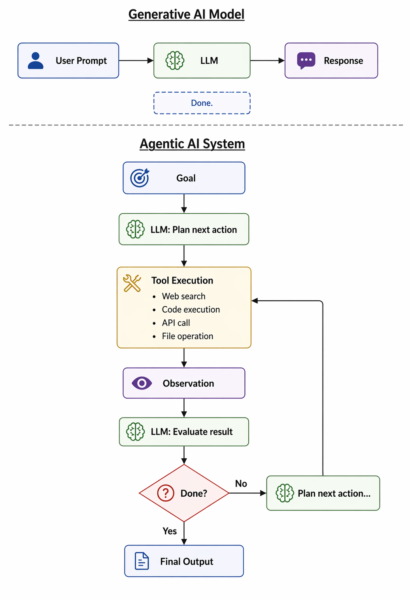
The agent has tools — functions it can call to interact with the world. It uses the LLM to decide which tool to use, interprets the result, and decides what to do next. This is fundamentally different from a generative model simply predicting the next token in a response.
Agentic AI vs Generative AI: Side-by-Side Comparison

| Dimension | Generative AI | Agentic AI |
|---|---|---|
| Core function | Generates content from a prompt | Pursues goals through autonomous multi-step actions |
| Interaction pattern | Single turn: prompt in, output out | Multi-turn loop: plan, act, observe, adapt |
| Tools and actions | None — produces text/content only | Can call APIs, search the web, write and run code, read/write files |
| Memory | Limited to context window | In-context, external (vector DB), and episodic memory |
| Human involvement | Human provides each prompt | Human sets the goal; agent executes autonomously |
| Task complexity | Single, well-defined tasks | Complex, multi-step workflows with branching paths |
| Typical use cases | Writing, coding assistance, Q&A, image generation | Research automation, autonomous coding, workflow orchestration |
| Risk profile | Hallucination, bias, IP concerns | All GenAI risks plus: unintended actions, runaway loops, data access |
| Maturity in 2026 | Mature and widely deployed | Rapidly maturing; production deployments scaling fast |
Real-World Examples That Make the Difference Clear
Generative AI in Action
You paste a job description into ChatGPT and ask it to write a tailored cover letter. You submit a buggy function to Claude and ask it to explain and fix the issue. You describe a product shot to Midjourney and receive four image options. In each case: one prompt, one response, done. The AI generates something and your involvement continues from there.
Agentic AI in Action
You give a coding agent (like Cursor in agent mode or Devin) a GitHub issue: “Add OAuth2 login to the user service.” The agent reads the relevant codebase files, identifies which services are affected, writes the implementation across multiple files, runs the test suite, interprets failures, fixes them, and opens a pull request — without you doing anything between setting the goal and reviewing the result.

Or: you give a research agent a question — “What are the top five compliance software vendors for AML in 2026, and how do their pricing models compare?” The agent searches the web, visits vendor websites, reads pricing pages, cross-references review sites, and produces a structured comparison — autonomously, across a dozen tool calls, in minutes.
Use Cases: Where Each Approach Fits
| Use Case | Best Fit | Why |
|---|---|---|
| Drafting a blog post | Generative AI | Single-turn content generation task |
| Autonomous competitive research | Agentic AI | Requires multi-step web search, reading, and synthesis |
| Code autocomplete in an IDE | Generative AI | Real-time, single-step prediction task |
| Implementing a full feature from a ticket | Agentic AI | Multi-file edits, testing, iteration required |
| Customer Q&A chatbot | Generative AI | Single-turn responses from a knowledge base |
| Autonomous customer support resolution | Agentic AI | Needs CRM lookups, order status checks, refund processing |
| Image generation for marketing | Generative AI | Prompt-to-image, single turn |
| End-to-end report generation from live data | Agentic AI | Requires data retrieval, analysis, and formatting across multiple steps |
Why the Distinction Matters for Businesses
Different Risk Profiles
Generative AI risks are well understood: hallucination, bias, copyright, data privacy. These are serious but contained — the model generates text and a human decides what to do with it. Agentic AI introduces a new category of risk: the agent takes actions in the world. It can make API calls, modify files, send emails, and interact with external systems. A misaligned instruction or a hallucinated tool call can have real consequences that are harder to reverse than incorrect text.

Different Governance Requirements
Deploying a generative AI tool in a business context requires content policies, output review workflows, and data handling guidelines. Deploying an agentic AI requires all of that plus: scope boundaries (what can the agent access?), action approval workflows (which actions require human sign-off?), audit logging (what did the agent do and why?), and rollback procedures (how do we undo unintended actions?).
Different Skills to Build
Effective use of generative AI is primarily a prompting skill — learning to write clear, specific, well-structured prompts that elicit high-quality output. Effective use of agentic AI requires understanding agent architectures, tool design, memory systems, and how to scope goals precisely enough that an autonomous system can pursue them safely and reliably.
The Trajectory: Where Both Are Heading
Generative AI is maturing rapidly. Models are getting faster, cheaper, and more accurate. Multimodal capabilities — handling text, images, audio, and video together — are becoming standard. The competitive differentiation is shifting from raw capability to domain fine-tuning, integration, and cost efficiency.
Agentic AI is earlier in its maturity curve but advancing faster than generative AI did at the equivalent stage. The key developments to watch in 2026 and beyond:
- Longer-horizon planning: agents that can reliably execute tasks requiring hundreds of steps without going off track
- Multi-agent collaboration: networks of specialised agents that delegate subtasks to each other, coordinated by an orchestrator agent
- Improved tool reliability: more consistent tool-calling behaviour across edge cases and ambiguous instructions
- Better memory systems: agents that maintain coherent context across long tasks and multiple sessions
Frequently Asked Questions
What is the difference between agentic AI and generative AI?
Generative AI produces content — text, images, or code — in response to a single prompt. Agentic AI pursues goals autonomously over multiple steps, using tools to act in the world, observing results, and adapting its approach. Generative AI is a building block; agentic AI is a system built on top of it.
Is ChatGPT generative AI or agentic AI?
ChatGPT in its standard form is generative AI — it responds to prompts. However, ChatGPT with tools enabled (web browsing, code interpreter, custom GPT actions) has agentic capabilities, as it can take actions beyond generating text. The line is becoming blurred as platforms add more tool-calling and autonomous capabilities.
What is agentic AI used for?
Agentic AI is used for complex, multi-step tasks that require autonomous action: autonomous coding (writing and testing code from a feature description), research automation (searching, reading, and synthesising information across many sources), workflow automation (orchestrating multi-system business processes), and customer support (resolving issues by interacting with CRM, order, and billing systems).
Can generative AI become agentic AI?
Yes — by adding an orchestration layer, tools, and a goal-directed loop around a generative AI model. Most agentic AI systems today use LLMs (generative models) as their reasoning engine. The difference is architectural: it is the system around the model, not the model itself, that makes a system agentic.
What are the risks of agentic AI compared to generative AI?
Agentic AI carries all the risks of generative AI (hallucination, bias, privacy) plus additional risks from autonomous action: unintended real-world consequences from incorrect tool calls, scope creep beyond intended boundaries, runaway loops consuming excessive resources, and harder-to-reverse actions like sending emails or modifying databases.
What is an AI agent?
An AI agent is an agentic AI system — software that uses an LLM to autonomously plan and execute multi-step tasks by calling tools, observing results, and adapting its actions until a goal is achieved. Examples include coding agents (Devin, Cursor), research agents, and customer support agents.
What frameworks are used to build agentic AI systems?
Popular frameworks for building agentic AI include LangChain (most widely used, large integration ecosystem), LlamaIndex (strongest for document-heavy RAG agents), Anthropic Agent SDK (native Claude tool use and multi-agent support), AutoGen (Microsoft, multi-agent conversation patterns), and CrewAI (role-based agent team orchestration).
Is agentic AI ready for production use in 2026?
Yes, for well-scoped use cases with appropriate human oversight. Fully autonomous agents with open-ended goals still require careful design and guardrails. Narrow agents with defined tools and clear success criteria — such as a coding agent for a specific codebase or a research agent for a defined domain — are delivering reliable production value at many companies in 2026.
How does memory work differently in agentic AI vs generative AI?
Generative AI is stateless between calls — each prompt starts fresh unless you explicitly include prior context. Agentic AI systems can maintain in-context memory (conversation history), external memory (vector databases of past interactions and retrieved documents), and episodic memory (structured records of past task runs) — allowing coherent, informed behaviour across long tasks and multiple sessions.
What jobs or skills will agentic AI affect most?
Agentic AI will most significantly affect roles involving structured, multi-step knowledge work: software engineering, research, data analysis, customer support, compliance, and content production. It will not eliminate these roles but will substantially change how they operate — shifting humans toward goal-setting, oversight, judgment, and handling the edge cases that autonomous systems cannot reliably navigate.
Conclusion
Generative AI and agentic AI are not competing categories — they are successive layers of capability. Generative AI gave machines the ability to produce high-quality content from natural language. Agentic AI gives machines the ability to pursue goals through action. Together, they represent the most significant shift in how software gets built and used since the internet.
The practical takeaway for 2026: generative AI is a productivity multiplier for individual tasks; agentic AI is a workforce multiplier for entire workflows. Understanding where each applies — and how to deploy both responsibly — is quickly becoming one of the most valuable skills in technology and business.
If this article helped clarify the landscape, subscribe to the PetaFusion newsletter for regular deep-dives on AI trends, agent architectures, and practical guides for building with the latest AI capabilities.