Every year, the United Nations estimates that between $800 billion and $2 trillion is laundered through the global financial system — roughly 2 to 5% of global GDP. Yet most people, including many who work in financial services, have only a vague understanding of what money laundering actually is, how it works in practice, and why it is so difficult to stop. This guide answers those questions clearly, without jargon, and explains why understanding money laundering basics matters more than ever in 2026.
Whether you are new to AML compliance, studying for a financial crime certification, or simply trying to understand what money laundering means in the real world, this article covers everything you need to know — from the definition and the three stages of the process to real-world examples and how regulators are fighting back.
What Is Money Laundering? The Simple Definition

Money laundering is the process of making illegally obtained money appear to have come from a legitimate source. The term comes from the idea of “washing” dirty money until it looks clean enough to spend, invest, or transfer without attracting attention.
Criminals generate money through illegal activities — drug trafficking, fraud, corruption, human trafficking, tax evasion, and cybercrime among others. The problem is that spending or investing large amounts of cash from these activities leaves a trail that law enforcement can follow. Money laundering solves this problem by passing the funds through a series of financial transactions that obscure their origin, making the money appear to have come from a legitimate business or investment.
The Legal Definition
In the United States, money laundering is defined under the Bank Secrecy Act (BSA) and the Money Laundering Control Act of 1986. Internationally, the Financial Action Task Force (FATF) — the global standard-setter for AML — defines money laundering as the processing of criminal proceeds to disguise their illegal origin. In most jurisdictions, both the act of laundering and knowingly facilitating it are criminal offences carrying significant prison sentences and financial penalties.
The Three Stages of Money Laundering

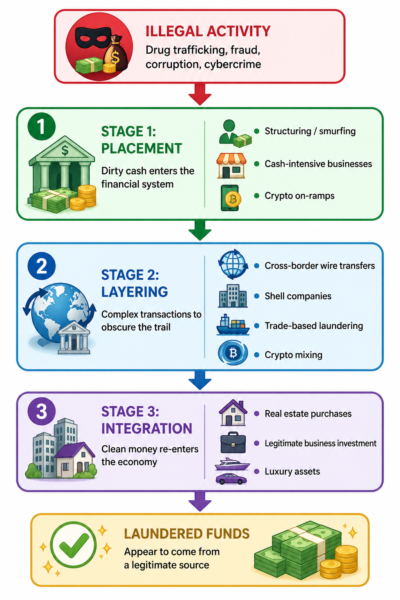
Money laundering almost always follows a three-stage process. Understanding these stages is the foundation of all AML compliance work.
Stage 1: Placement
Placement is the first and most dangerous stage for the launderer. This is when illegal cash — which is bulky, traceable, and difficult to move — enters the financial system for the first time. The goal is to deposit or convert the cash into a form that can be moved through the banking system.
Common placement techniques include:
- Structuring (smurfing): breaking large cash amounts into smaller deposits below reporting thresholds to avoid triggering Currency Transaction Reports. In the US, this threshold is $10,000.
- Cash-intensive businesses: mixing illegal cash with the legitimate revenues of businesses that handle large volumes of cash — restaurants, car washes, nail salons, and nightclubs are classic examples.
- Currency exchanges: converting cash into foreign currency, money orders, or prepaid cards to reduce its bulk and traceability.
- Crypto on-ramps: converting cash into cryptocurrency through peer-to-peer exchanges or unregulated platforms to enter the digital asset ecosystem.
Stage 2: Layering
Layering is the most complex stage. Once the money is in the financial system, the launderer creates as many layers of transactions as possible to separate the funds from their criminal source and make them difficult to trace. Think of it as creating a financial maze.

Common layering techniques include:
- Wire transfers through multiple jurisdictions: moving funds rapidly through accounts in different countries, exploiting differences in AML regulations and information-sharing limitations between jurisdictions.
- Shell companies: routing funds through layers of corporate entities with no real business purpose, often in secrecy jurisdictions where beneficial ownership is difficult to establish.
- Trade-based money laundering: manipulating the price, quantity, or quality of goods in international trade invoices to transfer value across borders without moving funds directly.
- Real estate transactions: purchasing and selling property, sometimes multiple times in quick succession, to create a paper trail of apparently legitimate investment activity.
- Crypto mixing and chain-hopping: using cryptocurrency mixing services or rapidly converting between different digital assets to obscure the transaction trail on public blockchains.
Stage 3: Integration
Integration is the final stage, where laundered funds re-enter the legitimate economy in a form that appears to have a lawful origin. At this point, the money is effectively clean — it has an apparent source (a business, an investment, a property sale) that can be pointed to if questions arise.
Common integration methods include:
- Purchasing luxury assets (real estate, yachts, art, jewellery) that can be sold later for clean proceeds
- Investing in legitimate businesses or stock market instruments
- Creating fictitious loans: a criminal lends themselves their own laundered money through a shell company, then “repays” the loan with clean income
- Inflated consulting or services invoices from shell companies that justify large payments with no real underlying work
The Three Stages at a Glance
Real-World Money Laundering Examples
The 1MDB Scandal
The 1Malaysia Development Berhad (1MDB) scandal is one of the largest money laundering cases in history. Approximately $4.5 billion was allegedly misappropriated from a Malaysian state investment fund, laundered through a network of shell companies, real estate purchases, luxury goods, and investments across multiple jurisdictions including the US, Singapore, and Switzerland. The case resulted in criminal charges across multiple countries and is a landmark example of how complex cross-border layering schemes operate at the highest level.
The Danske Bank Case
Between 2007 and 2015, approximately €200 billion in suspicious transactions flowed through the Number of big names, primarily from high-risk customers in Russia and other former Soviet states. The case exposed how correspondent banking relationships can be exploited for large-scale money laundering and led to significant regulatory reforms across the EU’s AML framework.
Everyday Smurfing

At the other end of the scale, structuring (smurfing) operations are common at street level. A drug network might recruit dozens of individuals to make cash deposits of $9,500 each — just below the $10,000 CTR threshold — at different bank branches across a city on the same day. Each individual transaction looks innocuous; the pattern across accounts reveals the operation.
Why Is Money Laundering So Hard to Detect?
Money laundering is notoriously difficult to detect for several reasons that go beyond the complexity of individual transactions.
| Challenge | Why It Matters |
|---|---|
| Volume | Trillions of transactions are processed daily globally — suspicious patterns are hidden in an enormous haystack |
| Sophistication | Professional money launderers study AML typologies and engineer transactions to stay below detection thresholds |
| Jurisdictional fragmentation | Layering operations exploit gaps in information sharing between financial systems across different countries |
| Secrecy structures | Shell companies, nominee directors, and secrecy jurisdictions obscure beneficial ownership |
| Correspondent banking | Banks process transactions on behalf of other banks without always having full visibility into the ultimate beneficial owner |
| Emerging channels | Cryptocurrency, NFTs, and digital assets provide new layering opportunities that traditional monitoring systems were not designed to cover |
The Anti-Money Laundering (AML) Framework: How Regulators Fight Back
Key Regulations and Bodies
The global AML framework is built on standards set by the Financial Action Task Force (FATF), an intergovernmental body that publishes recommendations adopted by 200+ jurisdictions. FATF’s 40 Recommendations cover customer due diligence, beneficial ownership transparency, suspicious transaction reporting, and international cooperation.
In the United States, the primary AML legislation is the Bank Secrecy Act (BSA), enforced by FinCEN. The EU operates under the Anti-Money Laundering Directives, currently in its sixth iteration (6AMLD), with a new centralised AML Authority (AMLA) established and becoming operational in 2025 and 2026.
Core AML Obligations for Financial Institutions
- Know Your Customer (KYC): verifying the identity of customers at onboarding and monitoring for changes in risk profile over time
- Customer Due Diligence (CDD): understanding the nature of the customer relationship, their source of funds, and the purpose of their transactions
- Enhanced Due Diligence (EDD): additional scrutiny for high-risk customers such as Politically Exposed Persons (PEPs) and customers from high-risk jurisdictions
- Transaction monitoring: ongoing surveillance of customer transactions to detect suspicious patterns
- Suspicious Activity Reports (SARs): filing reports with the financial intelligence unit (FinCEN in the US, NCA in the UK) when suspicious activity is identified
Money Laundering Penalties: What Is at Stake
The consequences of money laundering — and of failing to prevent it — are severe at both the individual and institutional level.
- For individuals: in the US, money laundering carries up to 20 years in federal prison and fines up to $500,000 or twice the amount laundered. In the UK, the maximum sentence under the Proceeds of Crime Act 2002 is 14 years.
- For financial institutions: regulatory penalties for AML failures can reach billions of dollars. HSBC paid $1.9 billion to US regulators in 2012. Deutsche Bank paid over $600 million in 2017. BNP Paribas paid $8.9 billion in 2014 across multiple financial crime violations.
- Reputational damage: beyond fines, institutions found to have facilitated money laundering face lasting reputational harm, loss of correspondent banking relationships, and restrictions on their ability to operate in key markets.

Frequently Asked Questions
What is money laundering in simple terms?
Money laundering is the process of making illegally obtained money look like it came from a legitimate source. Criminals pass the money through a series of financial transactions to disguise its true origin, so they can spend, invest, or transfer it without attracting attention from law enforcement.
What are the three stages of money laundering?
The three stages are placement (getting illegal cash into the financial system), layering (creating complex transactions to obscure the origin of the funds), and integration (reintroducing the laundered money into the legitimate economy in a form that appears lawful). Most money laundering investigations focus on identifying patterns across all three stages.
What is an example of money laundering?
A classic example is the cash-intensive business: a drug dealer buys a restaurant and mixes illegal cash proceeds with legitimate restaurant revenue, inflating reported sales. The combined income appears legitimate, passes through normal banking channels, and the criminal can now spend or invest the proceeds without suspicion. The 1MDB scandal is a high-profile example at the other extreme.
What is structuring (smurfing) in money laundering?
Structuring, or smurfing, is the practice of breaking large cash amounts into multiple smaller transactions to avoid triggering mandatory reporting thresholds. In the US, cash transactions over $10,000 require a Currency Transaction Report (CTR). Deliberately structuring transactions to avoid this threshold is itself a federal crime, regardless of whether the underlying funds are illegal.
What is the Bank Secrecy Act (BSA)?
The Bank Secrecy Act is the primary US federal anti-money laundering law, enacted in 1970 and significantly strengthened by the USA PATRIOT Act in 2001 and the Anti-Money Laundering Act of 2020. It requires financial institutions to maintain records of cash transactions, file Currency Transaction Reports and Suspicious Activity Reports, and implement AML compliance programmes.
What is FATF and why does it matter for AML?
The Financial Action Task Force (FATF) is an intergovernmental body that sets global standards for combating money laundering and terrorist financing. Its 40 Recommendations form the basis of AML laws in over 200 jurisdictions worldwide. FATF also conducts mutual evaluations of member countries and publishes a list of high-risk jurisdictions (the grey and black lists) that require enhanced due diligence from financial institutions.
What is a Suspicious Activity Report (SAR)?
A Suspicious Activity Report is a report filed by a financial institution with its country’s financial intelligence unit when it identifies a transaction or pattern of transactions that may involve money laundering, fraud, or other financial crime. In the US, SARs are filed with FinCEN. They are confidential and covered by a tipping-off prohibition — institutions cannot tell the subject of a SAR that a report has been filed.
What is trade-based money laundering?
Trade-based money laundering (TBML) involves manipulating international trade transactions — over-invoicing, under-invoicing, falsely describing goods, or making multiple invoices for the same shipment — to transfer value across borders without moving funds directly. FATF considers TBML one of the most significant and underdetected money laundering methods globally.
How is cryptocurrency used for money laundering?
Cryptocurrency is used in placement (converting cash to crypto via peer-to-peer exchanges), layering (mixing services, chain-hopping between different blockchains, and using privacy coins to obscure transaction trails), and integration (converting crypto back to fiat through exchanges with weak KYC controls). Blockchain analytics firms like Chainalysis and Elliptic have developed tools to trace crypto transactions and identify laundering patterns.
What is Know Your Customer (KYC) in AML?
KYC is the process by which financial institutions verify the identity of their customers, understand the nature of their business relationships, and assess their risk profile. KYC is a foundational AML obligation — you cannot monitor transactions effectively without first knowing who your customers are, what their business does, and what transaction patterns to expect from them.
What is the difference between AML and KYC?
KYC (Know Your Customer) is a component of AML (Anti-Money Laundering). AML is the broader framework of laws, regulations, policies, and controls designed to detect and prevent money laundering. KYC is the specific process of verifying customer identity and assessing risk — one essential element of a complete AML programme alongside transaction monitoring, SAR filing, and staff training.
Conclusion
Money laundering is not an abstract regulatory problem — it is the financial infrastructure that enables drug trafficking, human trafficking, corruption, and cybercrime to persist and scale. Every dollar successfully laundered makes the underlying crime more profitable and harder to stop. Understanding what money laundering is, how it works across its three stages, and why it is so difficult to detect is the foundation of every effective AML programme.
The tools for fighting it are improving significantly in 2026. Machine learning, graph analytics, and real-time transaction monitoring are changing the balance between launderers and the financial system. But technology alone is not enough. The first line of defence remains informed, well-trained people who understand what they are looking for and why it matters.
If this guide helped clarify the fundamentals, subscribe to the PetaFusion newsletter for in-depth coverage of AML compliance, financial crime typologies, and the technology reshaping the fight against dirty money.